Day 1
The liaison of four riders for this year’s main event, a loop to include the Netherlands and Belgium (Flanders), was a simple affair. Due to our home locations spread from south of the city to north of Nottingham, we all decided to catch the Robin Hood Line, alighting in Worksop. This plan reduced our first day’s riding distance to around the 100 kilometre mark. On East Midlands Trains, cycle coach provision is only designed for two bikes. It was a cosy affair at the point when the fourth rider boarded Coach C. Thankfully we were not challenged by the guard who kindly checked our tickets and moved on with a smile. And so it was, four cyclists, Neil, Dave, Colin and Andrew, set off in anticipation of adventure.
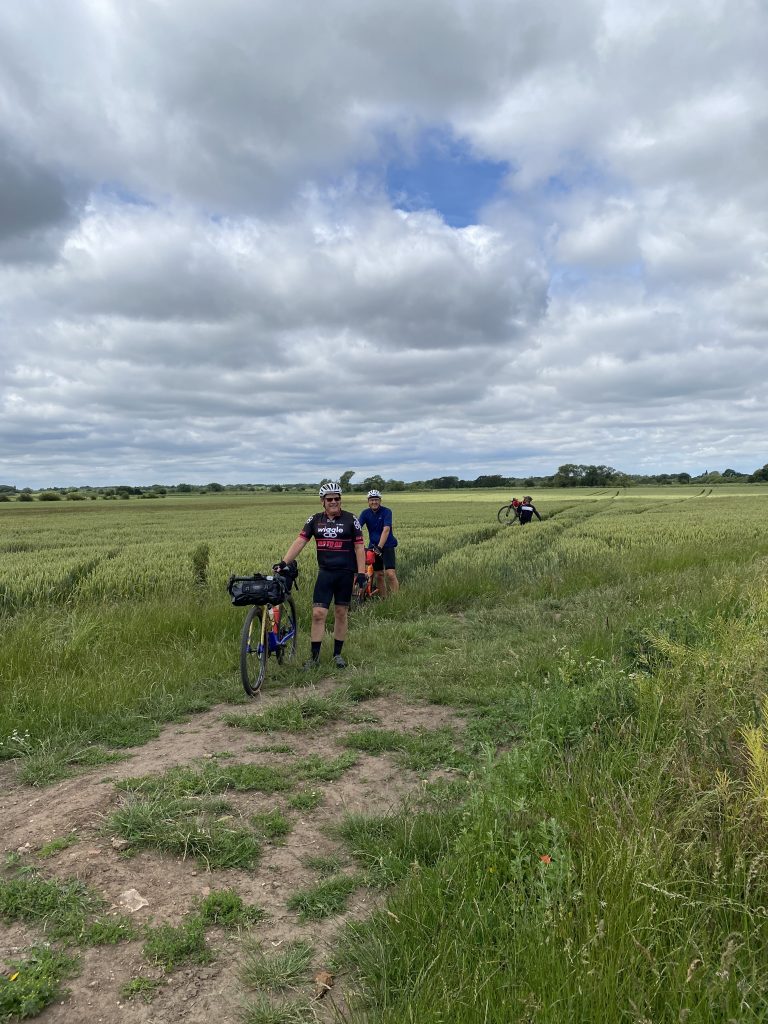
Shortly after leaving the station, we picked up a canal path out of Worksop and soon found good gravel leading onwards to the Wetland Lakes at Lound. The temperature was already climbing towards the day’s average of the high twenties by the time we reached a ‘hike-a-bike’ section through a cornfield. This useful shortcut reduced the distance travelled by road. Remounting our steeds we cycled onto Clayworth, Gringley on the Hill and then our first tea stop at a surprisingly good café situated in an industrial estate east of Misterton.
It was at this point that Dave experienced the first of his Di12 (electronic gear shifting) problems. Something that would worry us for the next few days as he suffered intermittent interruption at the rear derailleur. Thankfully, normal service resumed promptly and we made good progress as we followed the River Trent’s course towards the Humber. Day 1 was also the point where Dave picked up a puncture. He was not having much luck so far. We had all opted for a tubeless set-up but this was one of those occasions when a rip in the tyre was too large for the sealant to do its work, requiring us to plug the hole. From this point on Dave’s rear tyre would plague him with the slow escape of sealant and air.
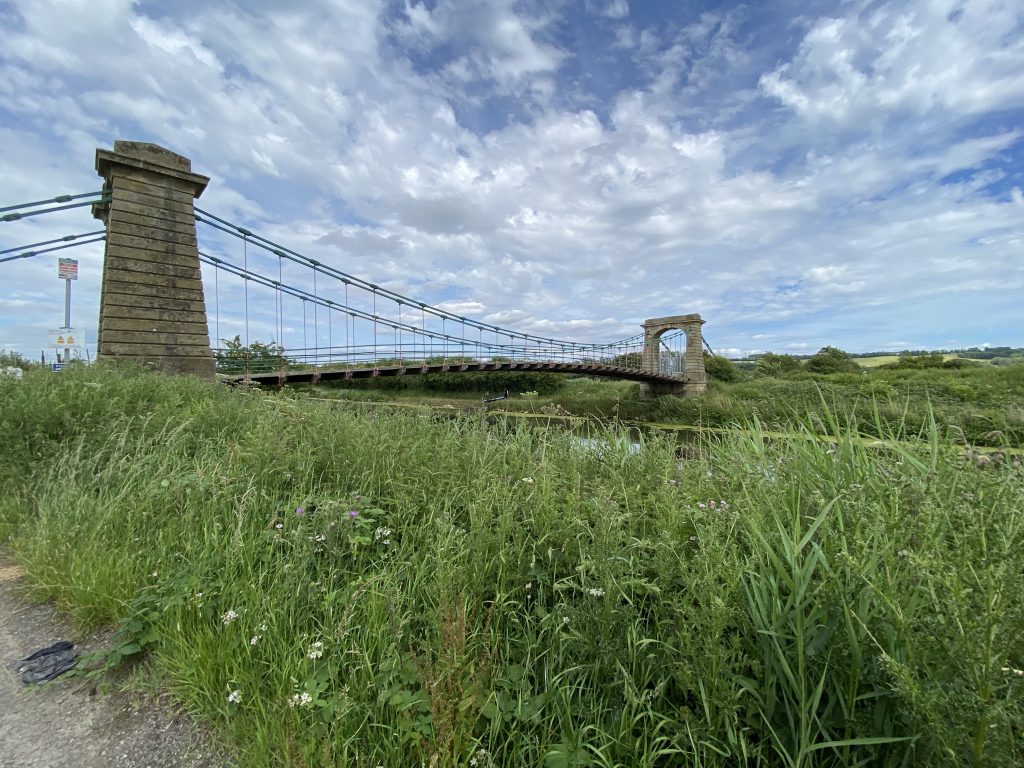
Deviating away from the River Trent at Flixborough we made our way alongside Normanby Hall Country Park and Roxby with the intention of crossing the River Ancholme at Horkstowe Bridge. Unfortunately, the bridge was closed for repairs causing us to back track and cross the River on the rather unpleasant A1077 via the village of Ferriby Sluice. We then followed the route to the Humber Bridge. Crossing into Hull we navigated our way as safely as we could through the city and onto the port.
By now, Colin, who had not had a chance to fully train for the ride, was feeling the strain and struggled up the ramp to the ferry. Never mind, all four intrepid riders had made it to the end of Day 1. The ferry provided adequate options for food, a few beers and a cosy cabin for four tired blokes to sleep off the day’s ride and recover. Just as well because Day 2 would turn out to be the longest, hardest and hottest day of the tour. We were on our way to the Netherlands!
Day 2
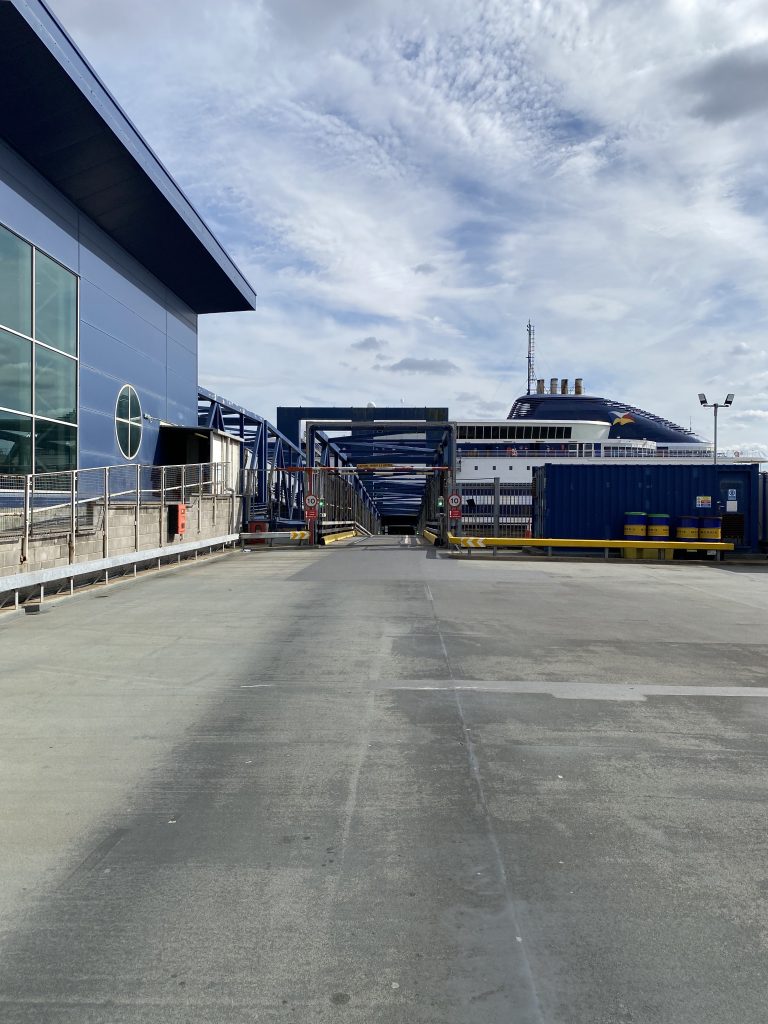
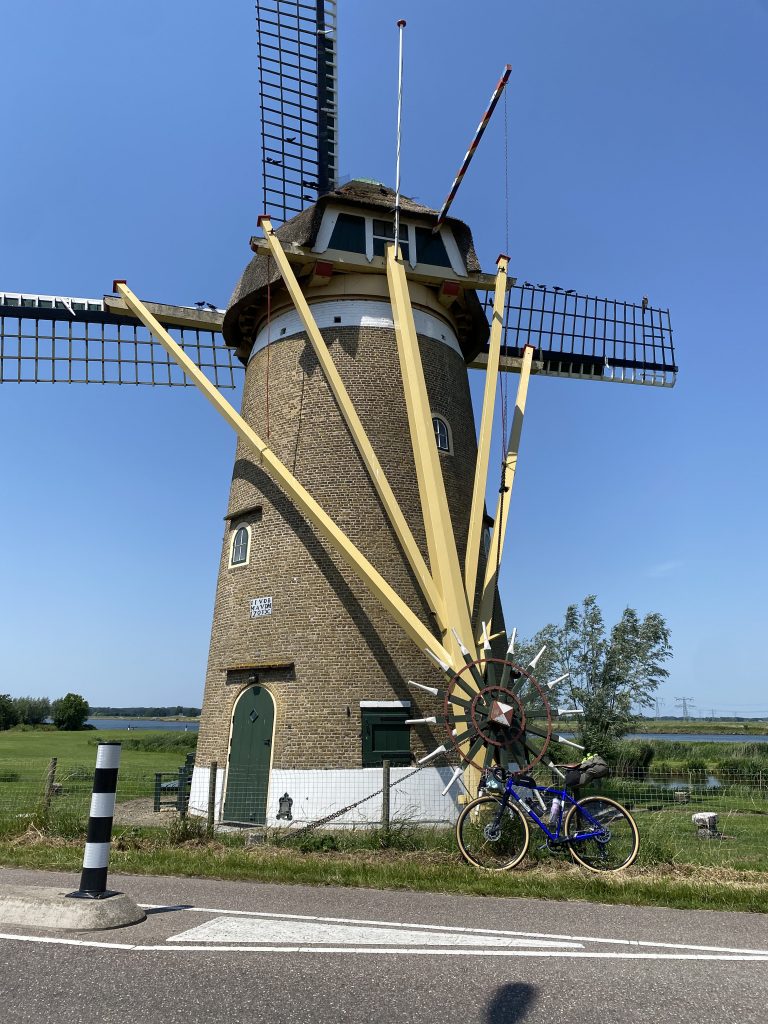
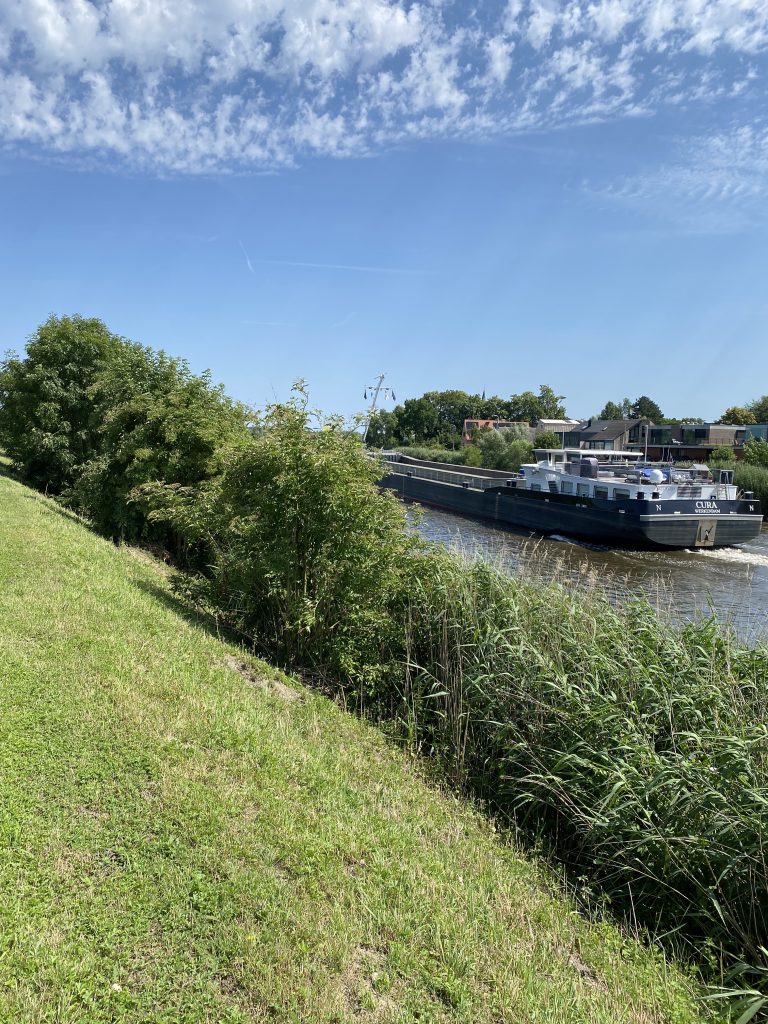
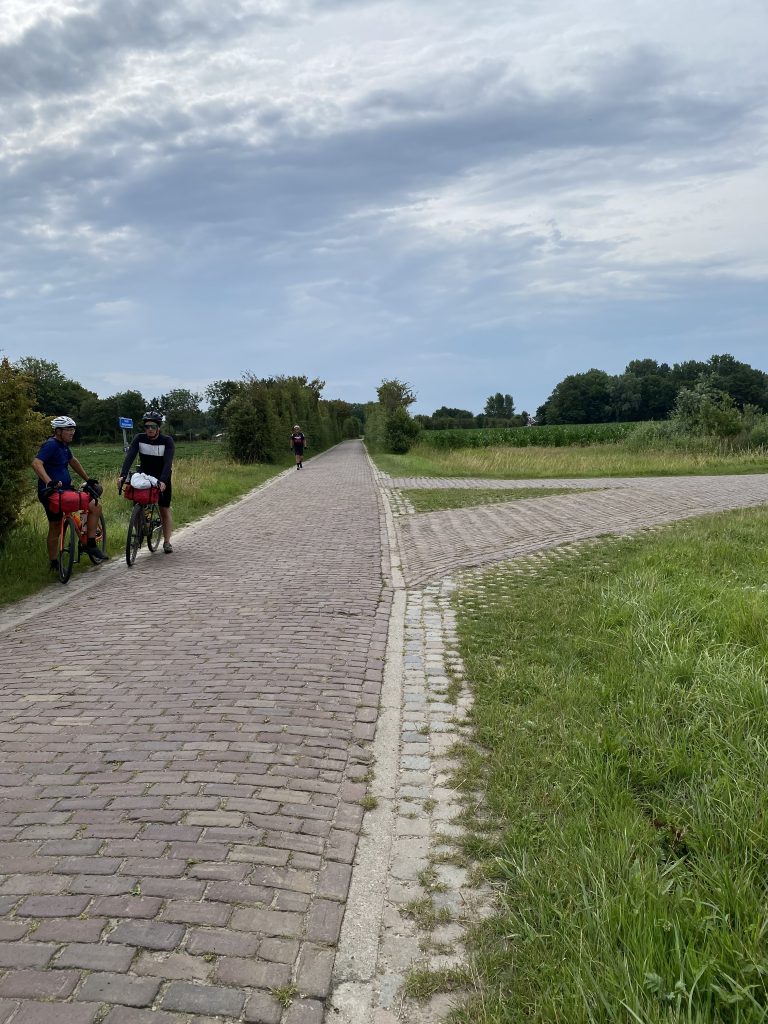
Leaving the Europort in Rotterdam was straightforward despite the countless reports of chaos caused by the new EU Entry, Exit System (EES). The contrast with our approach to the port of Hull could not be overstated. Despite Rotterdam being one of the busiest ports in Europe traffic out of the ferry terminal was light and the cycling lanes were wide, purpose built and easy to navigate. They made for good sightseeing as well. We passed over multiple estuaries with huge barges transporting goods in and out of the Netherlands. This was to be our longest day on the bike. Dave’s Di12 troubles returned and whilst taking a break, and the opportunity to refill our water bottles, at a service station a kind local informed us of a cycle shop close by. Sadly, the detour was in vain. The shop owner did not deal in or service electronically operated gears. After a supportive talk with Dave, it was agreed we were a team and should press on at his pace, which was limited to the pre-selected gear he had chosen. For now he was single speed. Thankfully, once again his gears started to work and we pressed on until our ride required a short ferry crossing at the town of Nieuw-Beijerland where we found an excellent tea stop. It was in fact a bakery shop, a little like Birds in the UK, but with a coffee shop included. The friendly lady was interested in our journey and stood talking to us in between customers. Typical of the warm welcome we were to receive from our Dutch hosts.
All cyclists will understand the term café legs, which describes the heavy legged feeling cyclists tend to get when they have sat too long mid-ride. Also, eating food requires the transfer of some of the body’s blood flow to the stomach for digestive reasons, making the heart & lungs work harder. In this case our café legs were met with a long section (6.5 km) into a headwind. I took the lead for the whole section and later wished I hadn’t. It’s an unfortunate personality trait of mine. If the going gets tough I tend to work hard to get it done as quickly as possible. Not really a good tactic on a bicycle, but one which benefits the other riders in a group situation.
Relief from the headwind came, or not, in the form of a road closure at the town of Oud Gastel. My attempt to persuade the workmen to let us through prompted a discovery that the Dutch have a sense of humour. “Cycling is your hobby, yes?” said the guy in his high viz vest of authority. I understood the sentiment of his comment, that we should get on our way. This added a couple of extra kilometres to our longest ride of the tour. We pressed on, Colin, who had suffered on the first day, was strong, teaching us how the body can adapt to workload. He certainly appeared fully recovered and rode well but within himself all day.
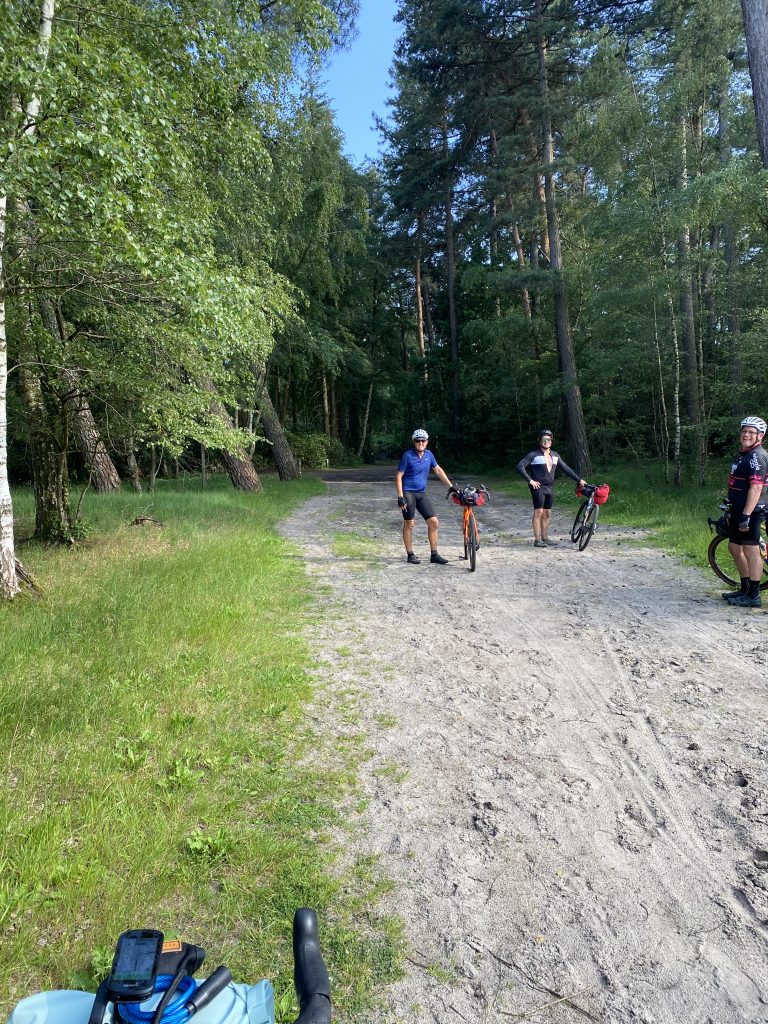
Our ride then took us through Wouw and Huibergen before navigating our way through the Grenspark Kalmthoute Heide, a 6,000 hectare nature reserve that spans the border between the Netherlands and Belgium. The initial forest trail gave way to sandy heathland that was, for a while, impossible to cycle. Our back wheels slipping and sliding causing Andy to take a tumble. It was at that point that we decided to walk. Soon however, we emerged in sight of Ossendrecht and crossed the border at Putte, where there stands the Jewish Cemetery. Eventually we arrived at the outskirts of Antwerp. We stopped to refill our water bottles at a Lidle supermarket. Outside we chatted to a young lady from Scotland who had been travelling around Europe on her bike, now alone but at times meeting friends along the route. I have much admiration for young people who seek to explore by bike, a reminder of my younger self. The bicycle can teach a young person so much about the world, the environment, people and themselves. We wished her luck on her future travels before embarking on our last leg to find our accommodation for the night.
It seemed to take us an age to cycle though the outskirts of Antwerp, with one wrong turn to add to the frustration. Arriving at the Ibis Budget Hotel, just by Antwerp Railway Station, we did little more than get showered, find a noodle bar for dinner, a quick pint in a local pub and then off to bed. Exploring Antwerp would have to wait until the morning. Garmin registered an average temperature of 34 degrees. This had been a great ride with excellent bike lanes, nature reserves, friendly people and beautiful towns and villages. But I personally had felt the heat.
Antwerp has its origins in the Celtic people of northern Europe and then the Roman empire. This Gallo-Roman population dates back to before 1500. Antwerp was later under the control of the German emperor Otto II as part of the province of Flanders, followed by the crusades. It grew in importance under the Duchy of Brabant (1500-1569). During this period Antwerp became an important trading port used by the English and Portuguese prompting the development of its own stock exchange.
When the Dutch revolt against Spanish rule broke out in 1568 the city lost its trade with the Spanish port of Bilbao and in 1576 Spanish soldiers ransacked the city. Known as the Spanish Furry, 8,000 civilians were massacred. The outcome of the Dutch revolt was that Antwerp’s banking was taken under the control of Genoa resulting in Amsterdam becoming the new trading centre. The golden age of Antwerp was over. Later in the 1800s Napoleon tried to revive the port as a possible challenger to the port of London but this was to no avail, in part due to Napoleon’s loss at the Battle of Waterloo. Eventually, Antwerp was taken over by the Belgium state.
Antwerp was a strategic location during World Wars I and II. After the Second World War, between 1956-1965 a Ten-Year Plan saw the port expanded and modernised. The city itself underwent a significant re-branding during the 1990s as a centre of fashion.
Today Antwerp is known for its Central Train Station, said to be one of the most beautiful in the world, its fine art that includes Rubens, Van Dyck and Van Eyck. There is a tunnel that takes the visitor under the Scheldt River with famous wooden escalators, it hosts a Museum of Book Printing and the city’s oldest building the Het Steen.
Day 3
My fellow travellers have come to know me as an early riser. At times a little sarcasm was injected into their observations of my sleeping, or not, habits. This morning a dawn awakening allowed me a look around Antwerp before we set off and just as the early commuters were making their way to work. Many of the buildings are tall and embody the wealth of Antwerp and its status as an international hub for diamond trading since the 15th century. This came about due to the strategic location of its port and the invention, by Lodewyk van Berken, of an advanced method of diamond polishing. The buildings around the diamond quarter are stunning. In recent times the industry has relocated to India diminishing Antwerp’s status within the diamond trade but the legacy was clear to see. The city’s railway station is impressive with multiple levels and grandeur that has to be seen to be believed. It certainly lived up to its reputation.
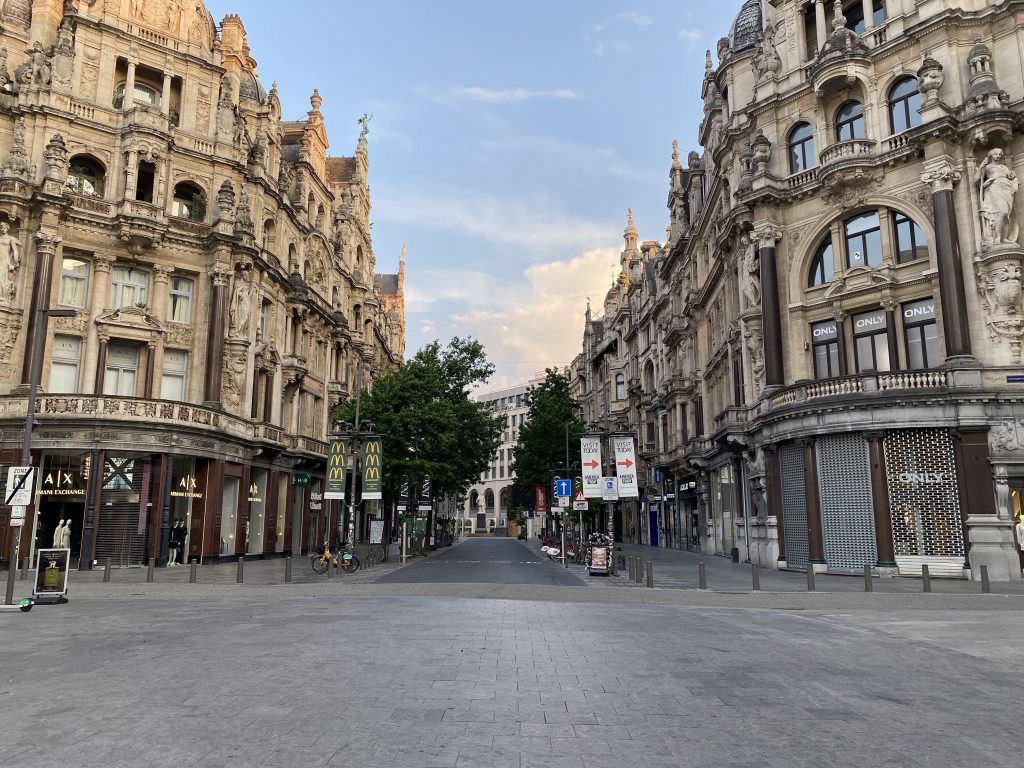
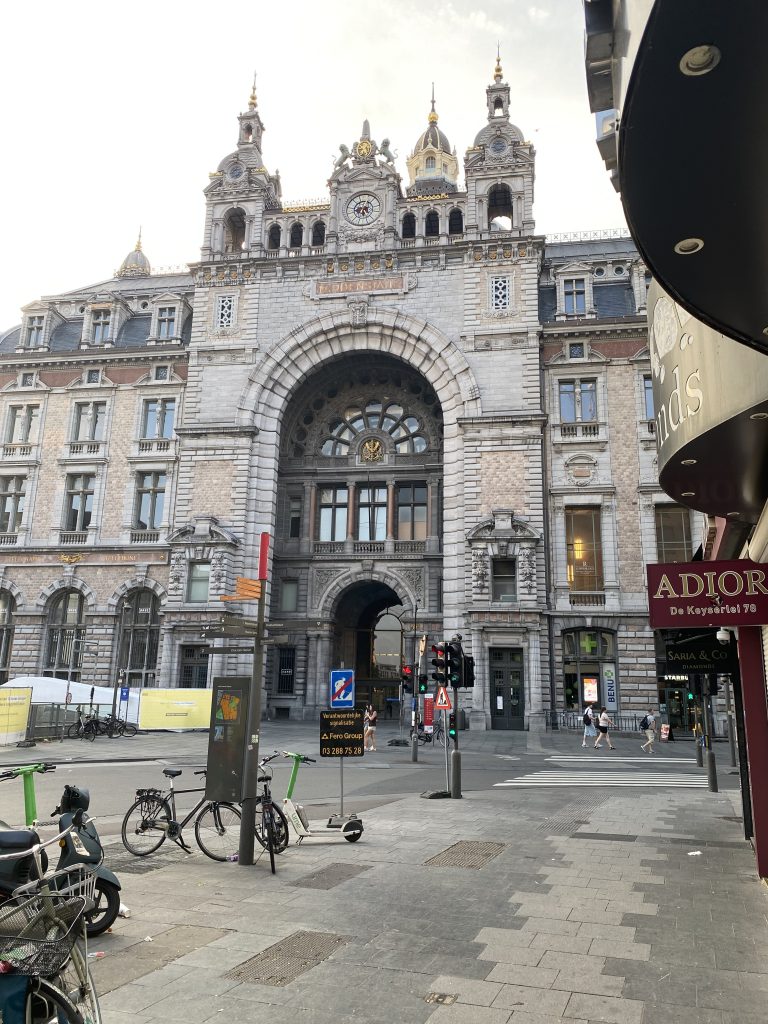
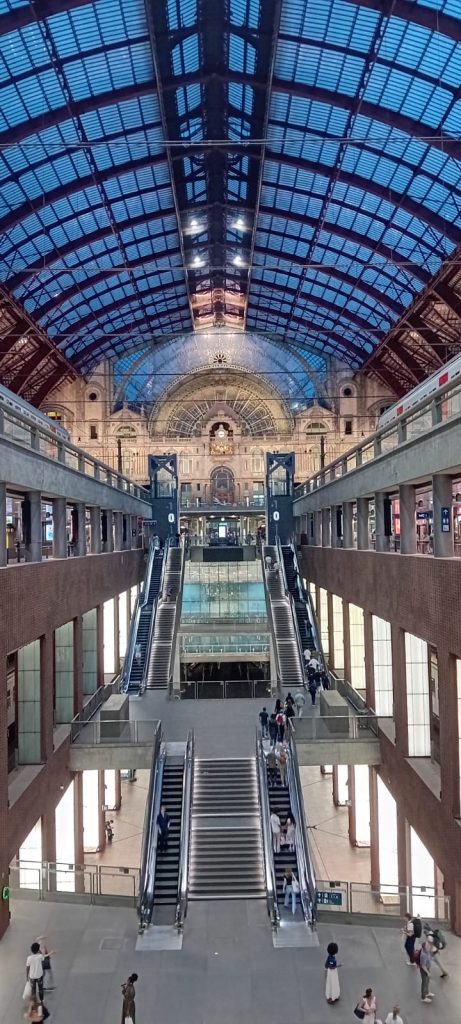
Returning to the hotel I met up with my travelling companions and we agreed to take breakfast at a nearby café opposite the station. This was more than sufficient to fuel the early part of our ride out of Antwerp. As we navigated our way west across the city I had forgotten about the tunnel under the river Scheldt. Maybe this is a sign of ageing because during my pre-tour research I’d deliberately designed the crossing into the route in order to experience both the tunnel and famous wooden escalators. In fact, access to the tunnel on the west bank is via a large lift that took us 26 meters below the water level. We then rode the 1.8 kilometre tunnel until arriving at the exit point. There were two options to return to the surface, either another lift or the wooden escalator. We of course chose to use the escalator. An unusual experience to say the least. Emerging out into the early morning light the day was warming up as we headed southwest towards Ghent.
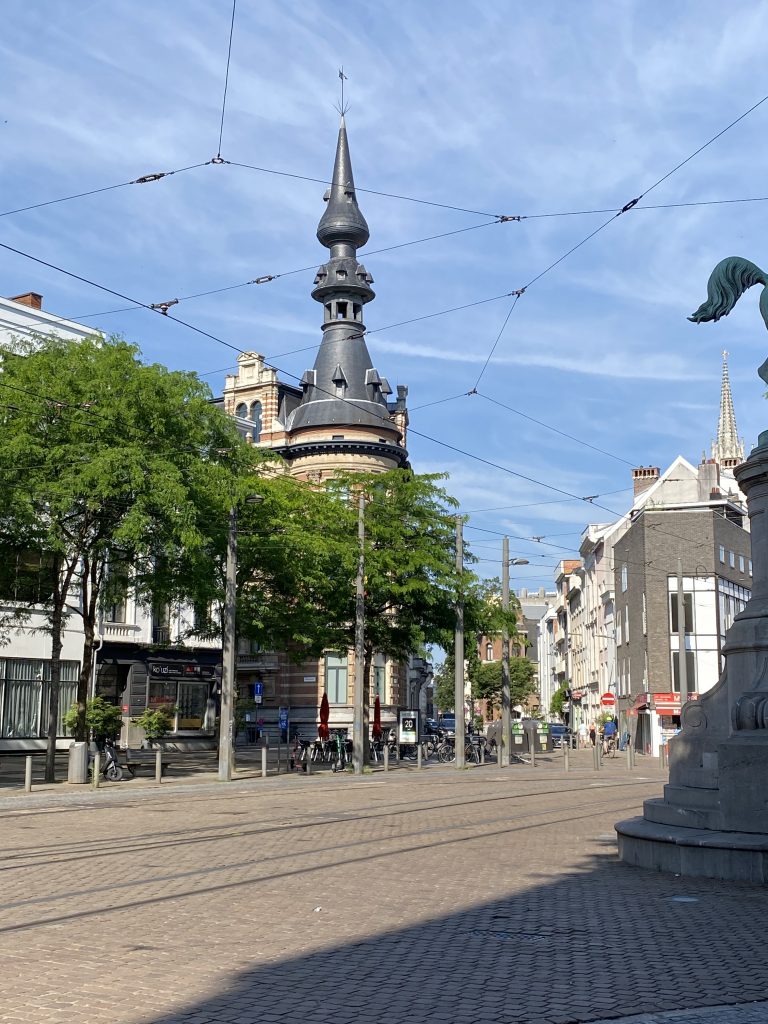


The journey from that point onwards was a rather pleasant affair, mainly cycle lanes in open countryside. The crosswind shifted to an easterly, at times providing a little assistance. We were never into a full on headwind, much to our relief. A café stop was made at Haasdonk after which we experienced our first taste of Belgium cobbles, a short section just before the town of Bergstraat. By this time Dave had already reacquainted himself with Di12 trouble, but we pressed on, once again the intermittent fault with the rear derailleur resolving itself.
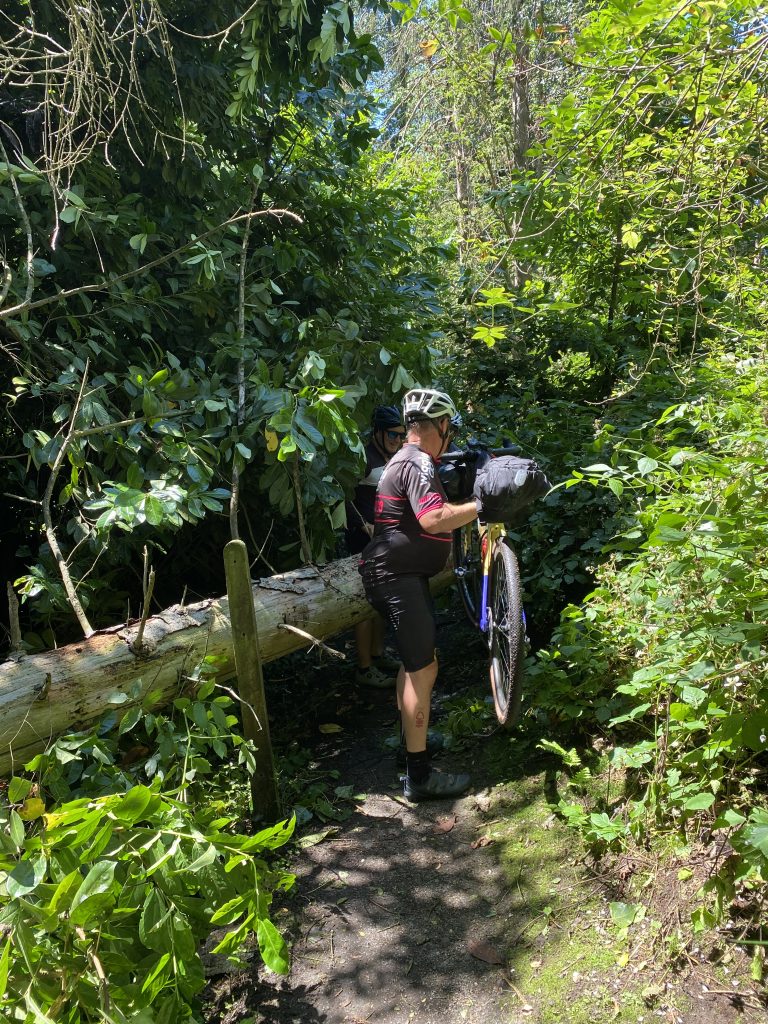
From there it was onwards to Temse and heading towards the larger conurbation of Schrijverswijk before returning to the banks of the Scheldt River. All the time the cycle lanes allowed good, safe progress through towns and into the countryside. Apart from a short single track section where we had to lift our bikes over a fallen tree.
Along the route there were many fallen trees. Luckily we had picked the heatwave rather than the previous week’s storms. Yet more representation of the weather extremes Europe now faces.
We tracked the river for several kilometres until we hit a lane closure. Renovation work was taking place on the cycle track. After looking for diversion options, we could see a cyclist who had passed around the barrier and was making her way in the direction we wished to travel. We deferred to local knowledge and also made our way around the barrier, cycling initially but then walking as the churned up earth became muddy. We eventually caught up with the cyclist who was a woman in her 50s on an electric bike. By this time, we had reached the end of the construction work. A second barrier blocked our passage to the open cycle path, proving a little trickier than the first. This time there was a fence over a ditch which made our covert activity challenging. We also recognised there was no way the lady, on her electric bike, would be able to clamber through without some assistance. She clearly didn’t have that much local knowledge! And so, we formed a human chain of helpers, lifting our own, fully laden bikes, and the electric bike around the barrier, under the fence and over the ditch. Then off we sped with a cheery goodbye having performed our good deed of the day.
We were now on the outskirts of Ghent. Whilst our route only reached the fringes of the city, it is worth setting out the importance of Ghent. Ghent became a manufacturing hub for the wool industry but also boasts a medieval castle with a moat. Caught up in the war between the English and French, England blocked the import of raw materials forcing Ghent merchants, and by default the city, to take England’s side during the Hundred Years War (1338-1345). After victory by the French the city had to cut its ties with England in 1407. Ghent was known as a rebellious city and even rebelled against its own child prince, Charles V. Somehow, in the complex power struggles and allegiances that dominated Europe, Ghent lost its passage to the sea and the economic situation deteriorated. However, the second half of the 18th Century saw revival and renewal. Under Dutch administration Ghent established a university and became an important sea port thanks to the Ghent-Terneuzen Canal. That did not stop Ghent placing itself at the centre of the struggle for independence against the Dutch and the House of Orange. The city developed as a leader during the industrialisation of Europe. Thankfully Ghent remained largely undamaged during World War II.
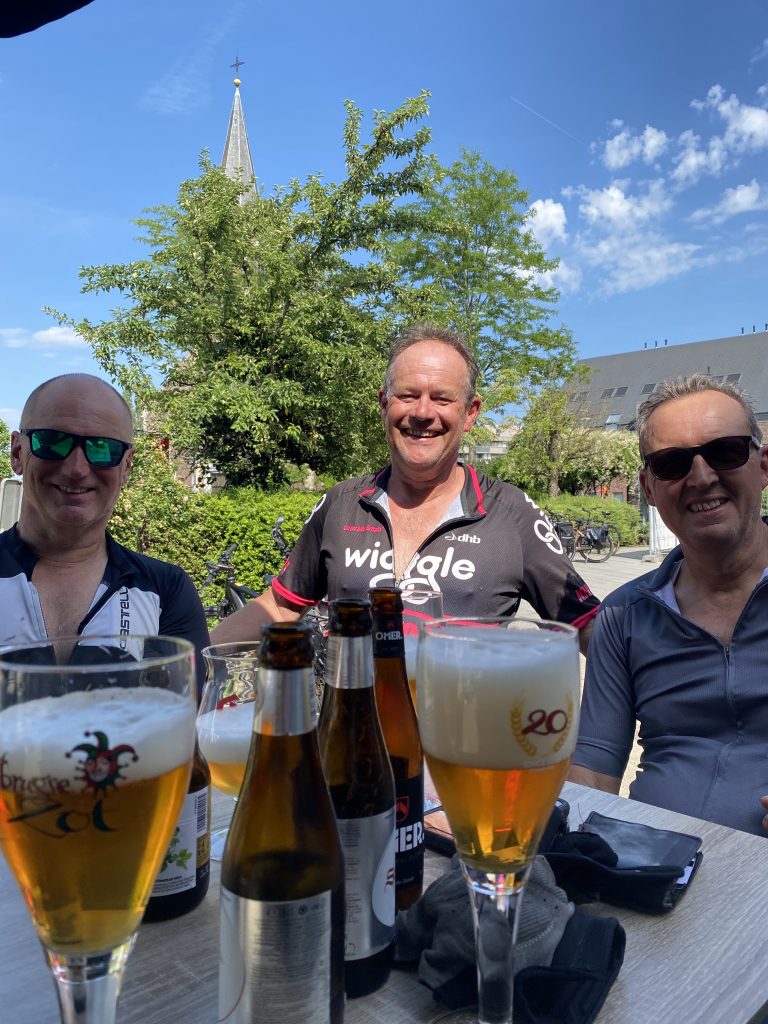
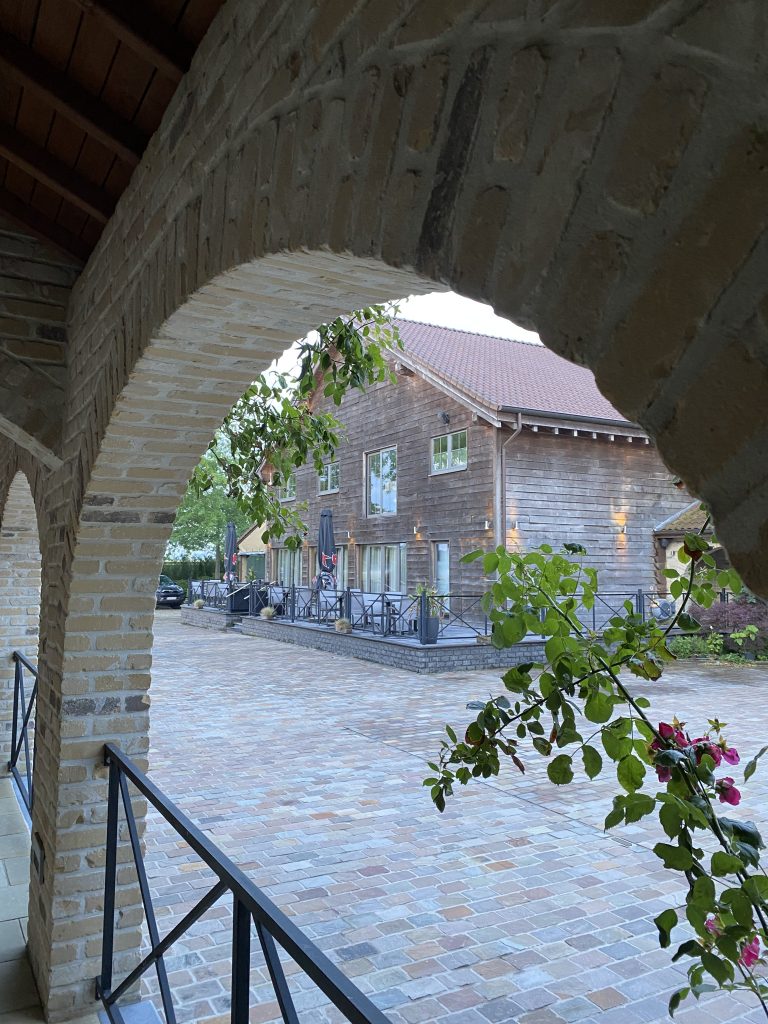
After Ghent we made a final café stop for a beer before rolling onwards to our accommodation for the night. The beautiful Country Lodge Hotel at Moriaanshoofd. We were now in prime Flandrien cycling territory and on checking in the host was keen to tell us how cyclists such as Mark Cavendish and a young Tadej Pogačar had stayed there. Testing his cycling knowledge, we explained we lived close to the home of Tom Simpson, whom he’d never heard of, so we took his claims with a pinch of salt. He had lost some credibility as a cycling fan in my eyes. The hotel was, however, exquisite. Set in stunning countryside with well-appointed large rooms and a smart restaurant. Outside there was a terrace looking out onto the courtyard. The dinner was excellent, despite limited vegetarian options.
Day three had been a mixture of surfaces, a really enjoyable route that all four riders felt a positive vibe for. Beke, the nearest hamlet, was small with few facilities. One of the advantages and disadvantages of cycle touring is that the tourist has to space out overnight stops based on capability and preference. This often means stops in grand cities but also smaller towns and hamlets giving the tourist a feel for city, town and rural life. Developing an understanding for the counties one visits is all part of the experience. Beke is a good example of this. Set in the municipality of Waarschoot and Zomergem, Beke is a hamlet located in the Belgian province of East Flanders. Simply a beautiful setting.
Day 4
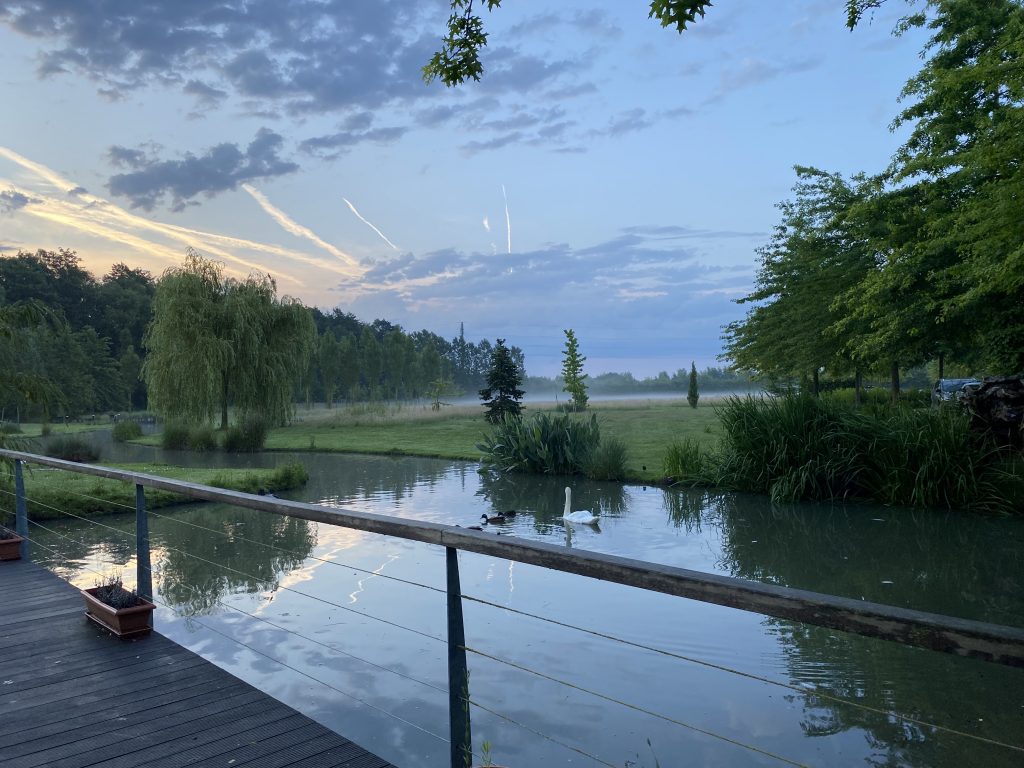
Predictably I had a chance to engage in my early morning walkabout. Meandering around the grounds that were shrouded in a mist from the overnight thunderstorm. Then followed a breakfast, included in the price, a help yourself affair with plentiful choice which set us up for the day.
We set off for the heart of Flanders with the sole purpose of getting a feel for one of the great Spring Classics of cycling. The Tour of Flanders itself, or ‘Vlaandeers Mooiste.’ The Spring Classics are what is known as the monuments of the sport, they include Milan-San Remo, Paris Roubaix, Liege-Bastogne-Liège, and the Giro di Lombardia. In more recent times the Strada Bianche (inaugurated in 2007) also, justifiably, claims to have become one of the spring classics.
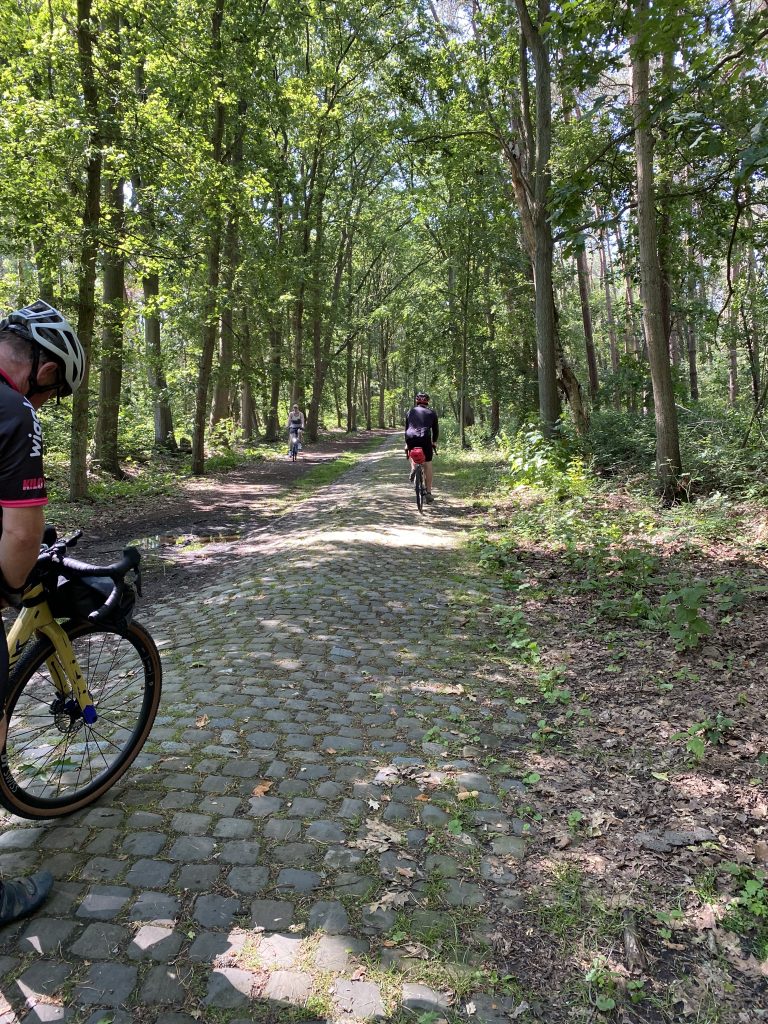
The Tour of Flanders was first held in 1913 and is one of two cobbled classics coming a week before the Paris Roubaix. We hoped to get a taste of the Flanders cobbles but also one of its most notorious cobbled climbs, the Koppenberg. The Koppenberg has been described as the most feared ramp in the region and was first included in the Tour of Flanders 1976. Often, in wet conditions, the steep cobbled climb is known for creating carnage in the peloton, impacting on the overall outcome of the race. Many riders resort to walking part of the climb as it is simply too difficult for them to ride. In fact it is so difficult to ride that the climb was removed from the Tour of Flanders for a number of years.
Some of the greats of cycling, known for their expertise in the great one-day races, have triumphed in Flanders, a few of whom have won it seven times. They include Achiel Buysse, Johnan Museeuw and more recently Mathieu van der Poel.
As the sun burnt the morning mist away we set off on what was to be another blisteringly hot day. As we made our way to collect out luggage and check out Dave spotted a nest of swifts under the lower eves of the hotel. The parents returning frequently to feed their chicks. It was a marvellous spectacle of nature.
Once again Dave’s Di12 was playing up, this time from the outset, but we pressed on. It was only a short ride to Oudenaarde, where we crossed the familiar Scheldt River with the beautiful church of Geboortekerk Pamele standing on its bank.

Not long afterwards we climbed the north, asphalt surfaced side of the Koppenberg. I was feeling strong and very confident putting distance between myself and the group to the top. This was a false confidence that soon evaporated in the heat at the top of the climb. Two riders had just made the accent and whilst we unpacked our bikes (to reduce weight for our attempt at the Koppenberg) I asked the most professional looking of the two if he knew anything about Di12. Having described the issue, he said it’s probably your batteries in the right gear lever. These were small watch type batteries. Having never owned an electronic gear shifting bike I was blissfully unaware of the additional batteries in the brake/gear levers. To be frank I have long since dismissed the whole concept of electronic gears for cycle touring. Best left to the professional peloton in my opinion.
As we stood there, discussing the pros and cons of Di12 a young lad on a 24 inch wheeled racer rode over the crest of the Koppenberg. His legs spinning without strain and only lightly breathing. The six bystanders (ourselves and the two riders who had just climbed the hill) applauded this picture of hope and ambition. Clearly a talented young man who smiled at our appreciation of his effort. I knew we would not be replicating his ability to make it look effortless.
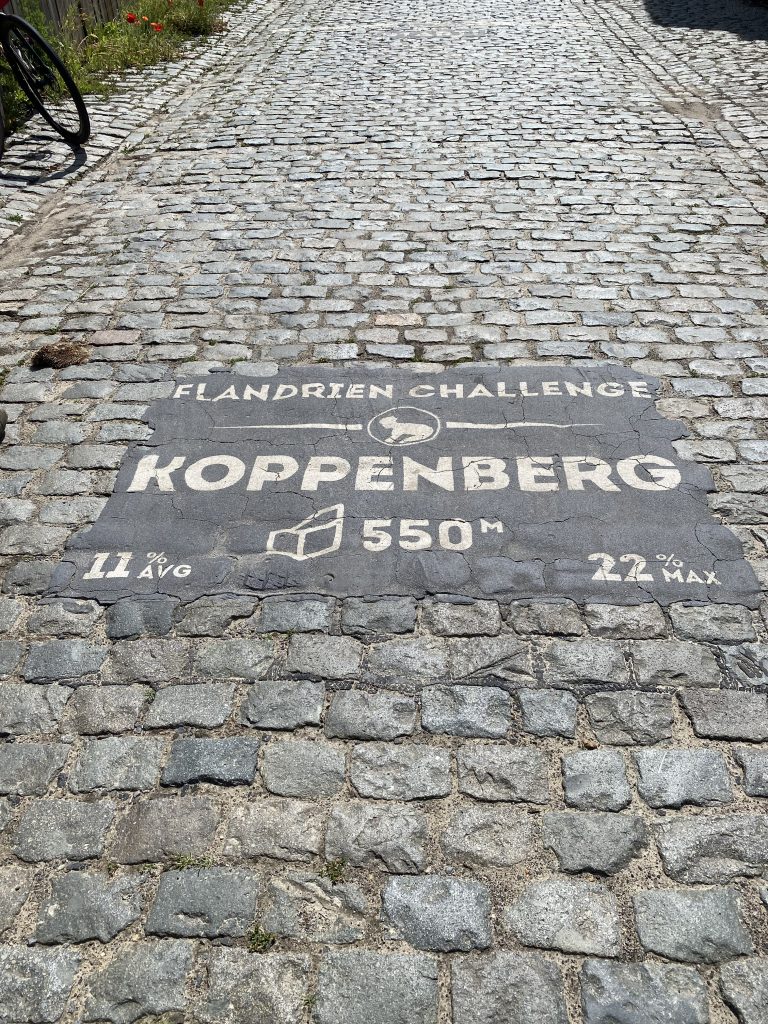

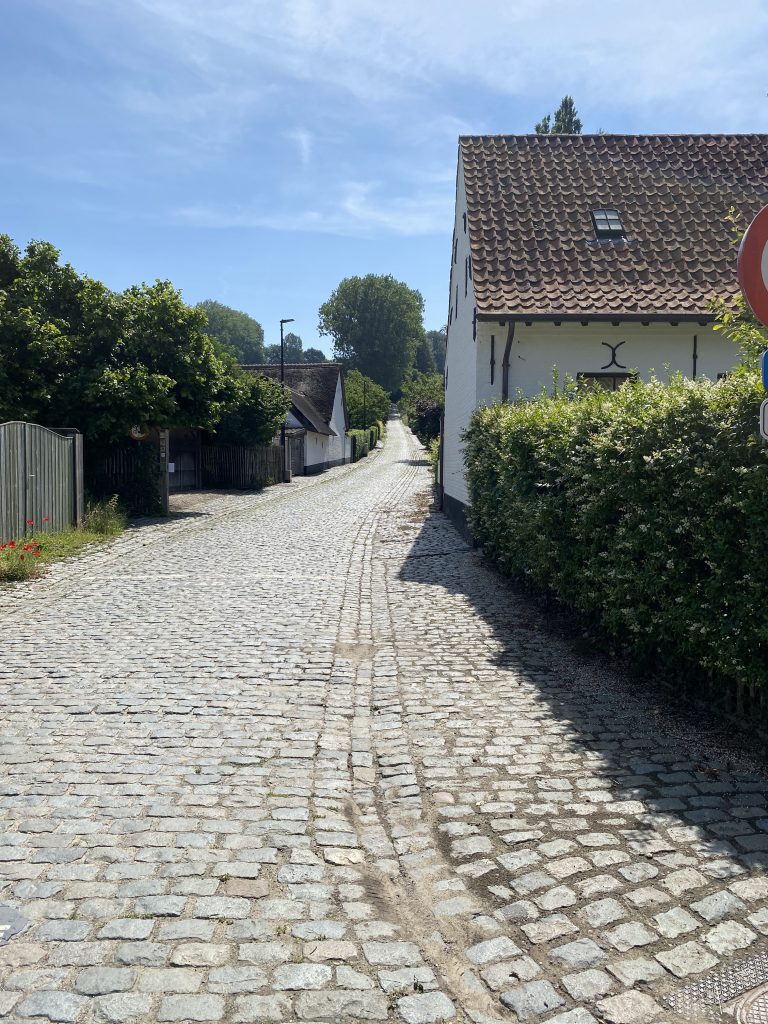
Having lightened our load we descended the Koppenberg, instantly realising that the cobbles made this a much greater challenge than the statistics would suggest. Despite the hot conditions overnight rain ensured that the cobbles in the wooded section remained wet and slippery. I’d read somewhere that there was an underground spring that ensures they always remain slippy. After a pre-climb pep-talk we made our accent, myself leading the way, slowly. Once in the wooded section I was losing traction on my slick tyres. They were the right choice for the majority of this smooth route but here not so. I was zig zagging to reduce the gradient whilst remaining seated for traction. The forty teeth on my single chainset was just not small enough, despite a dinner plate cog at the rear. An unknown rider passed me on a road bike but he soon became unstuck. Reaching the wet cobbles he fell off. I thought, ‘I’ve got you.’ I made it up the steepest section but by this time my breathing was so heavy that I thought better of it and climbed off to walk the remaining section. Dave, who had remained at the top, laughing and videoing my discomfort. Clearly it was payback time for my ridicule of his Di12’s.
It then became apparent that something had gone wrong behind me as the other two were nowhere in sight. Andrew had fallen off, luckily onto the soft embankment, I think Colin had stopped to help. And so, after a summit reenactment for the photo record, we all descended back down again, found a nice café in the village of Melden, that served coffee with chocolate mouse and cake. Dave swapped the batteries over on Dave’s Di12 so that at least he had a fully functioning rear derailleur, and, I licked my wounded pride at having been beaten by the Koppenberg.
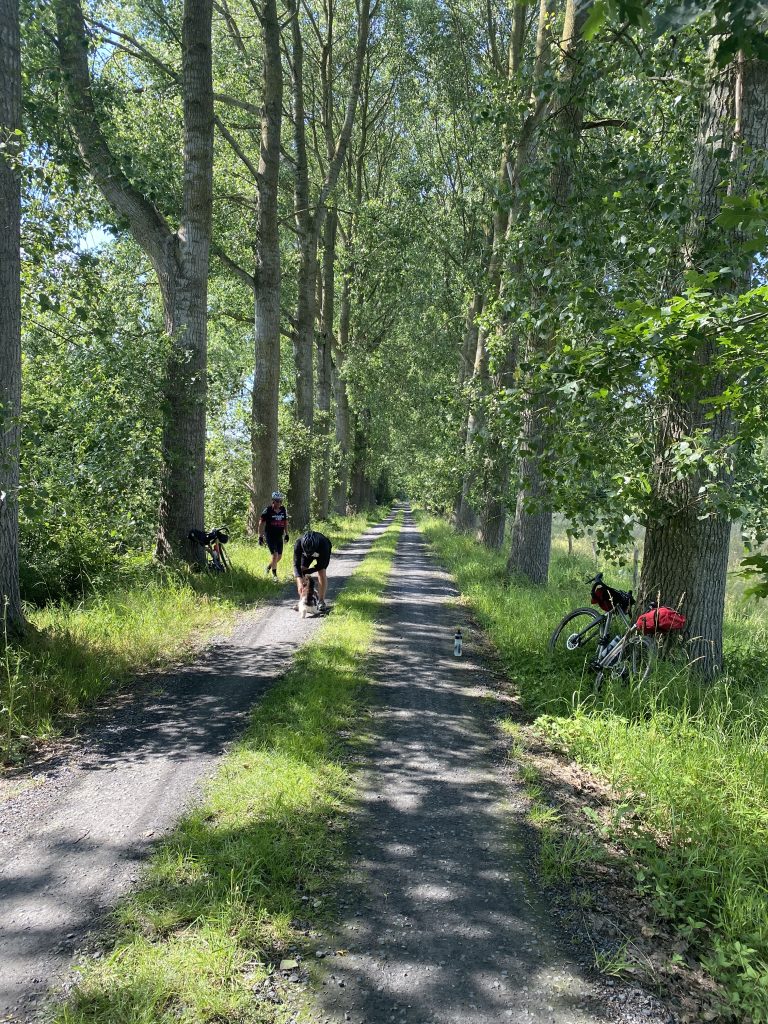
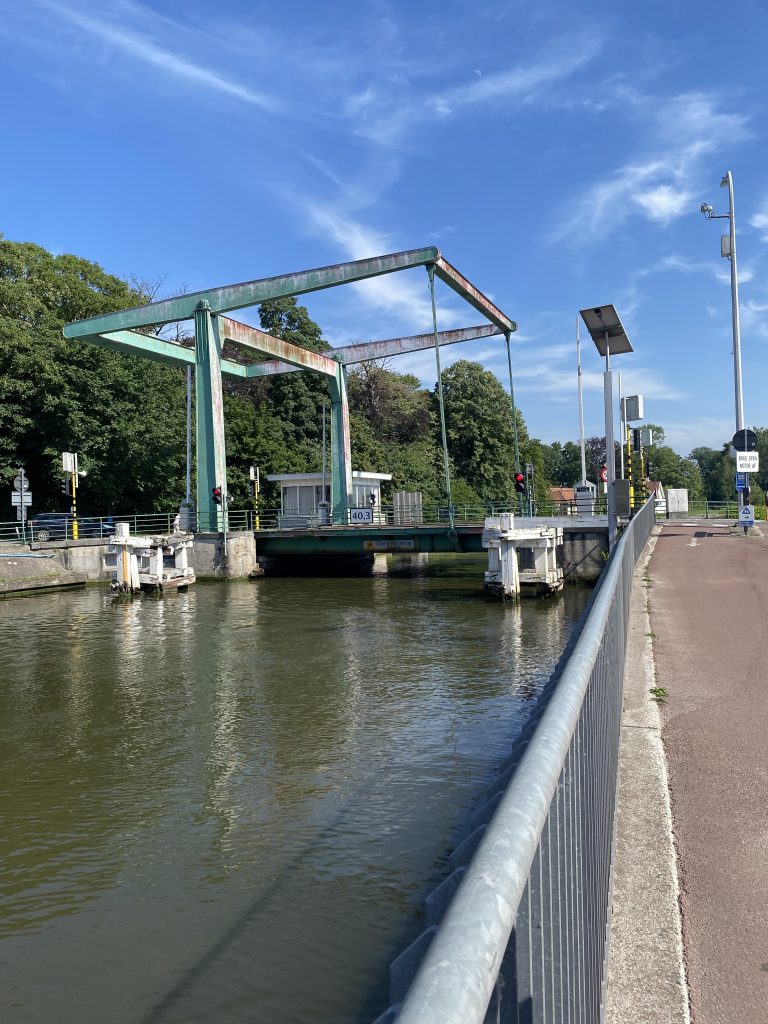
Following our break we returned to the road passing through Kluisbergen and Waregem before finding a final refreshment break in the town of Tielt . We found a bar that served cheese toasted sandwiches. They, and the cold coke were life savers. Whilst sitting outside a friendly local was interested in our journey and asked multiple questions about where we came from and our local football teams. He felt compelled to tell us how funny he thought it was that a town in Scotland went by the name of Twatt. This amused him for some time, he must have said the word Twatt several times, I think he liked saying it. We humoured him and moved the subject on as best we could. It was then onwards to Brugge via Wulfhoek and Oostkamp. The run into Brugge was alongside the river, only turning off to find our Hotel at the last moment. The smart Radisson Blu stands just by the railway station and conveniently placed for a short walk into the city.
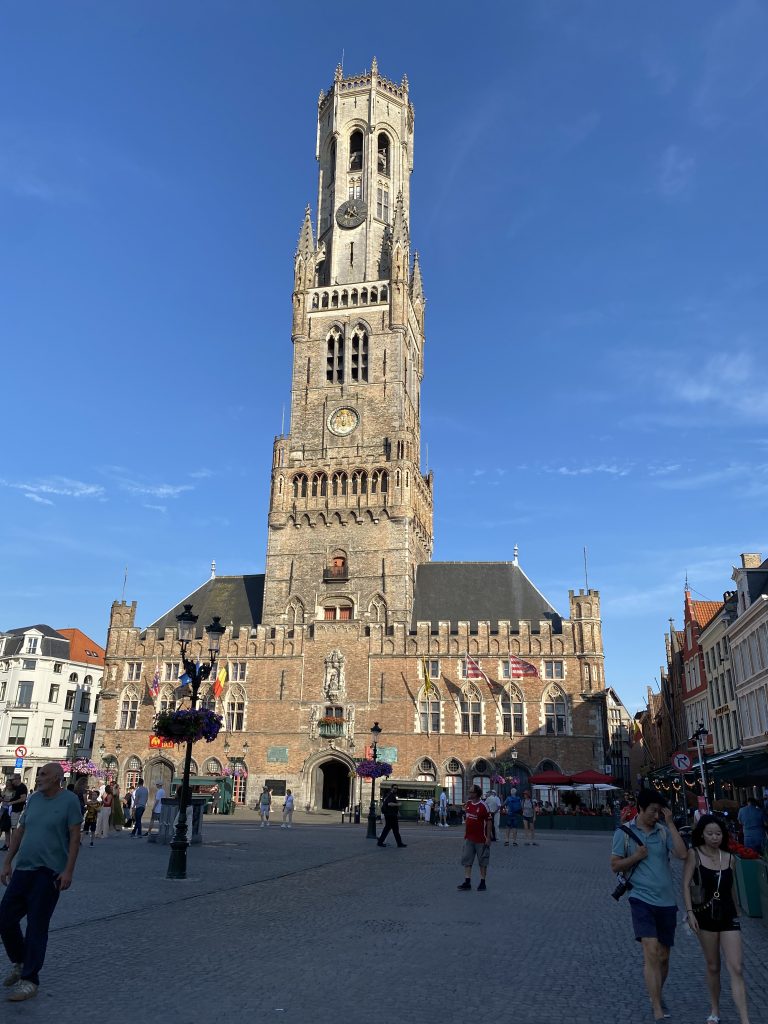
That evening we discovered the most picturesque city imaginable. Tall ornate stone buildings at every turn. Summer sunlight reflecting off the masonry. I have deliberately chosen to use the Flemish spelling for Brugge as this is a Flandrian tour but the French and English spelling is Bruges. The city dates back to Roman times and provided a strategic position. The Romans built a road along a sand ridge bordering Brugge making it a coastal defence against Viking raids. The name ‘Burg’ comes from the Dutch word for castle ‘burcht.’ Under rule of the Counts of Flanders Brugge became a trading centre, thanks to the city’s access to the sea. By the 14th century it became a highly developed trading centre with the world’s first stock exchange. During the golden age of Brugge, the dukes of Brugge invited fine artists and craftsmen to make the city the architectural masterpiece it is today. It is famous for the artist Jan van Eyck. From the late 1400’s the city fell into decline as Antwerp began to dominate trade. The website, Visit Bruges, describes how:
“Fuelled by religious and political differences [and] centuries of wars, changes in power followed. In the midst of all this, Bruges remained a Catholic city and belonged successively to the Spanish, Austrian, French and Dutch empires.”
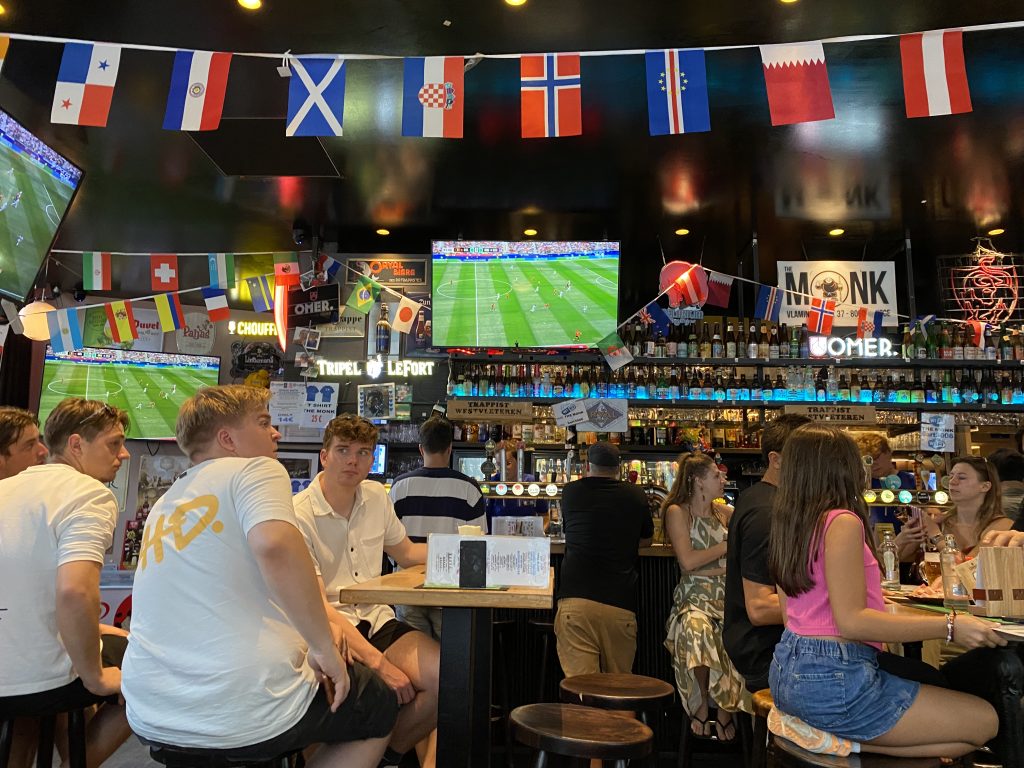
As visitors, we can reliably report Brugge is a city of immense beauty with a diversity of bars and restaurants to serve all tastes. That evening the Belgium football team were playing a group game in the Football World Cup. We had a great evening, sampling the finest Belgium beers and cheering on with the locals. In truth, I can’t even remember who they were playing, but it was for me a rare evening of drinking several beers, lubricating laughter late into the night. Thankfully we had our shortest ride of the tour that following morning.

Day 5
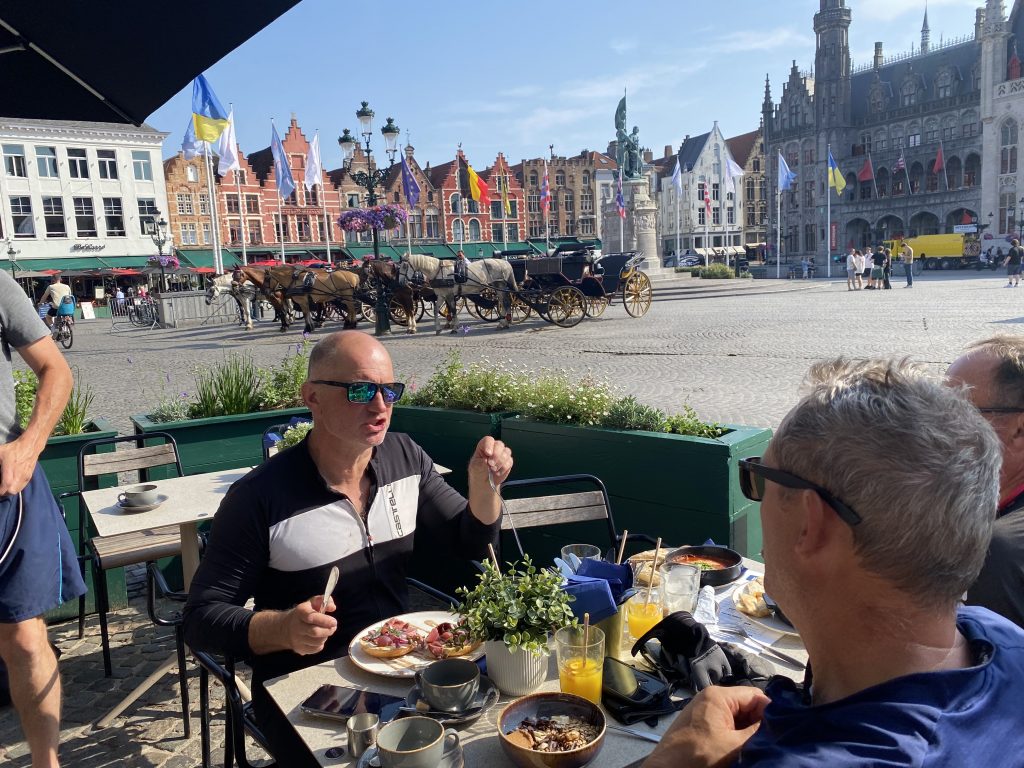
The next morning four blurry eyed riders made their way to the Grande Place, or Market Place, and ate breakfast in the most historical setting I have ever eaten. The Grand-Café faced the Historium Bruges. Horse drawn cabs lined up ready for a day’s work taking tourists around the city and we were looking forward to a short ride to Middelburg.
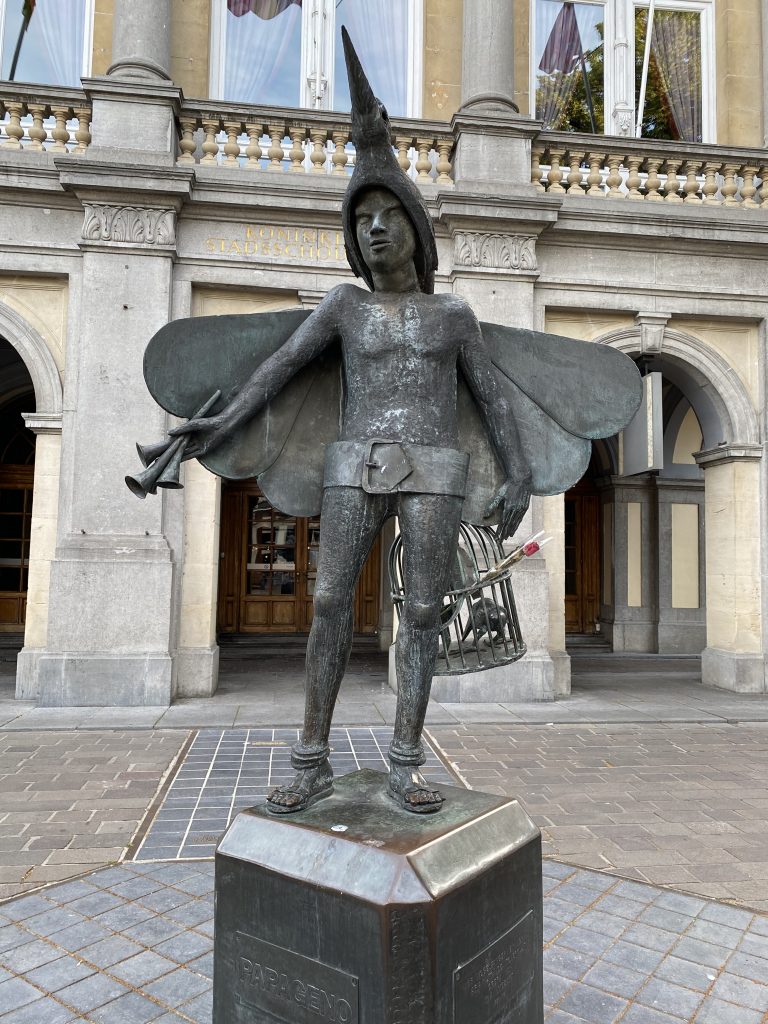
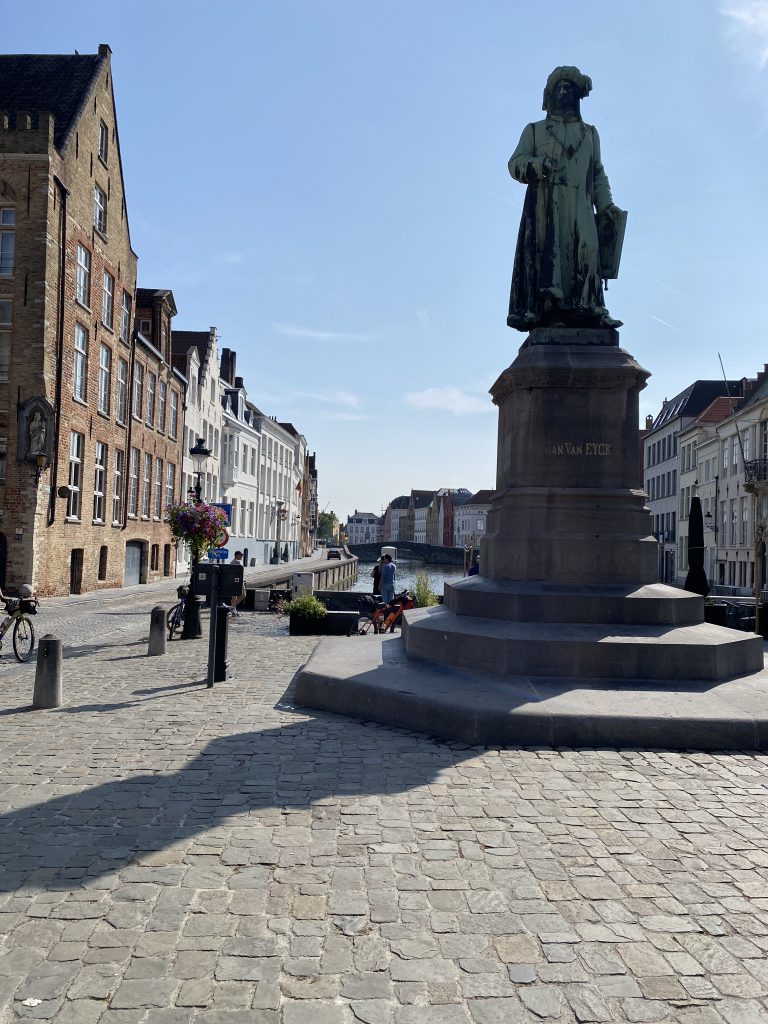
Our route out of the city followed narrow streets and canals until we picked up the straight course of a canal all the way to Sluis. Sluis had a tourist feel to it but was none the worst for that. The cycle track had sections of fine flint that cut through my lightweight tyres triggering the tubeless sealant to fizz on more than one occasion. But the sealant did its job unlike Dave’s set up which, having picked up the large tear on Day 1 was still losing air. From Sluis we then made a gradual curve north to pick up a coastal track that took us to the ferry terminal.
Today I had designed a shorter ride to take account of a ferry ride across the Scheldt estuary. We arrived in plenty of time to allow a pleasant lunch near the ferry port at Breskens. This was proving to be a day of easy enjoyment, apart from a little exuberance on my part, putting in a fast stint on the front as we tackled a straight uphill section, it was nice and relaxing.
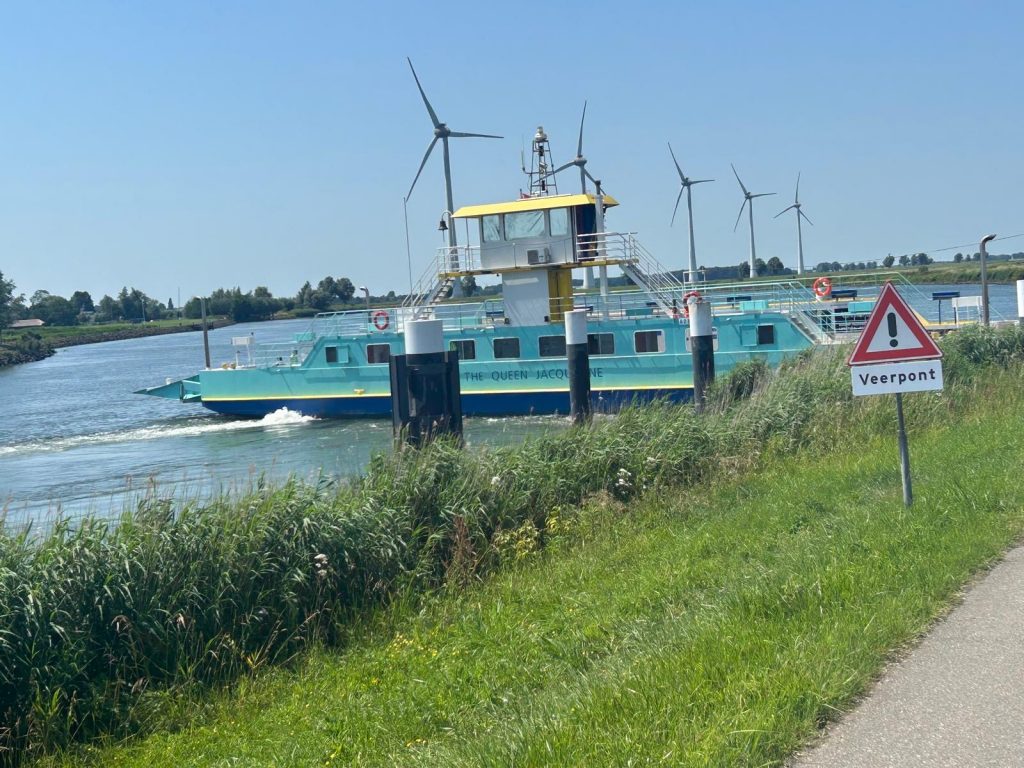
We had now returned to the Netherlands. The Breskins to Vissengen ferry was an efficient operation. Our pre-booked tickets were self-scanned and we walked on deck, secured our bicycles and climbed the stairs to the outside seating area, along with everyone else as it was a beautiful and clear day with blue sky and sea alike. There’s something fascinating about watching a vessel make its way out of port. My travelling companions stood and admired the scenery. I sat down near a lady who was travelling to her second home in Middelburg by bicycle, which is normal in the Netherlands. She explained how to take the car would require a much longer road journey over the road bridges. This conversation was prompted by my rather silly question; “where’s the swimming pool?” And, “is there entertainment later?” comparing the ferry to a cruise ship. My sense of humour must align with that of the Dutch as we then spent much of the 30 minutes sail time chatting about our journey and other matters of interest including my impression of Antwerp which was the lady’s birthplace.
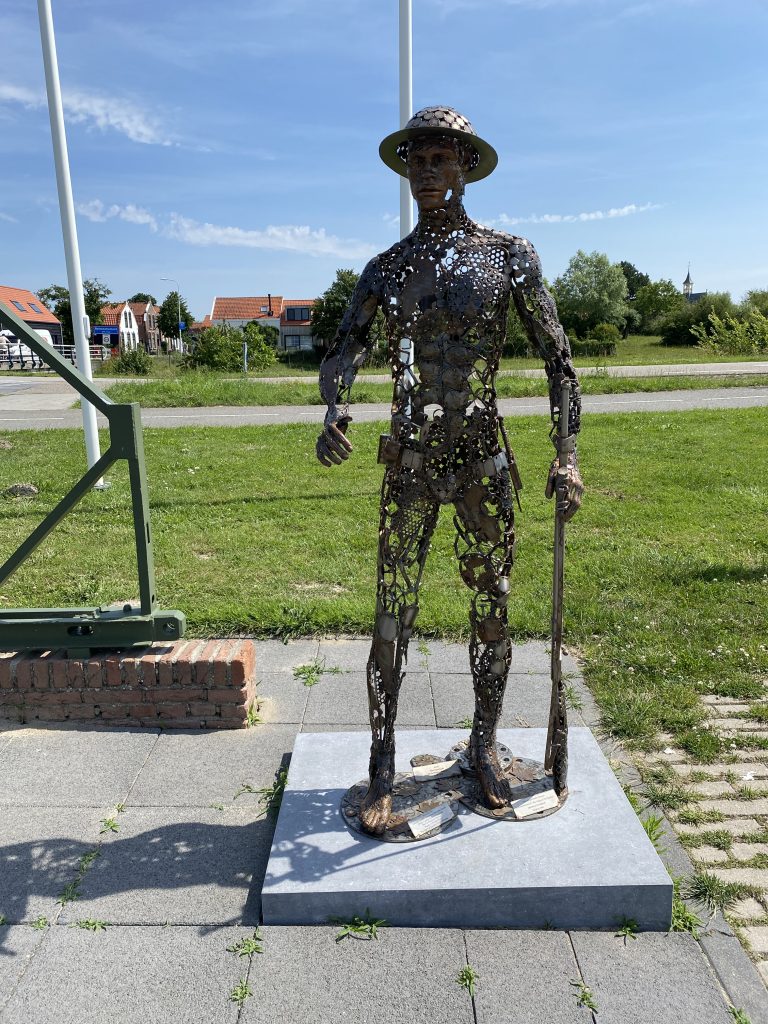
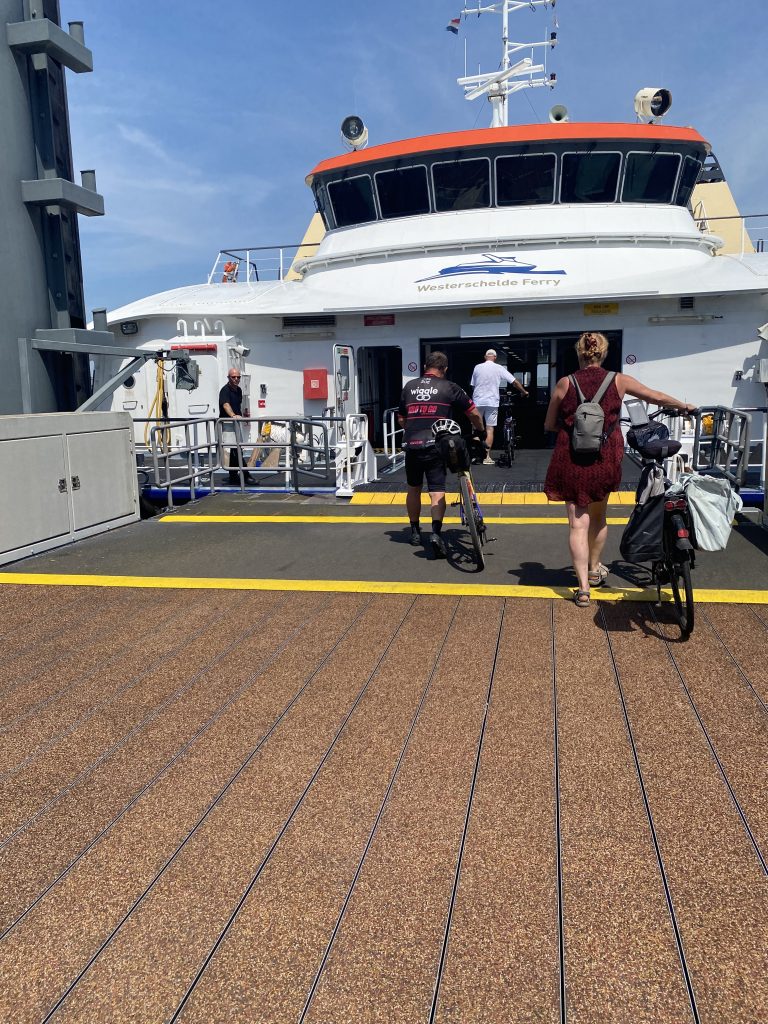
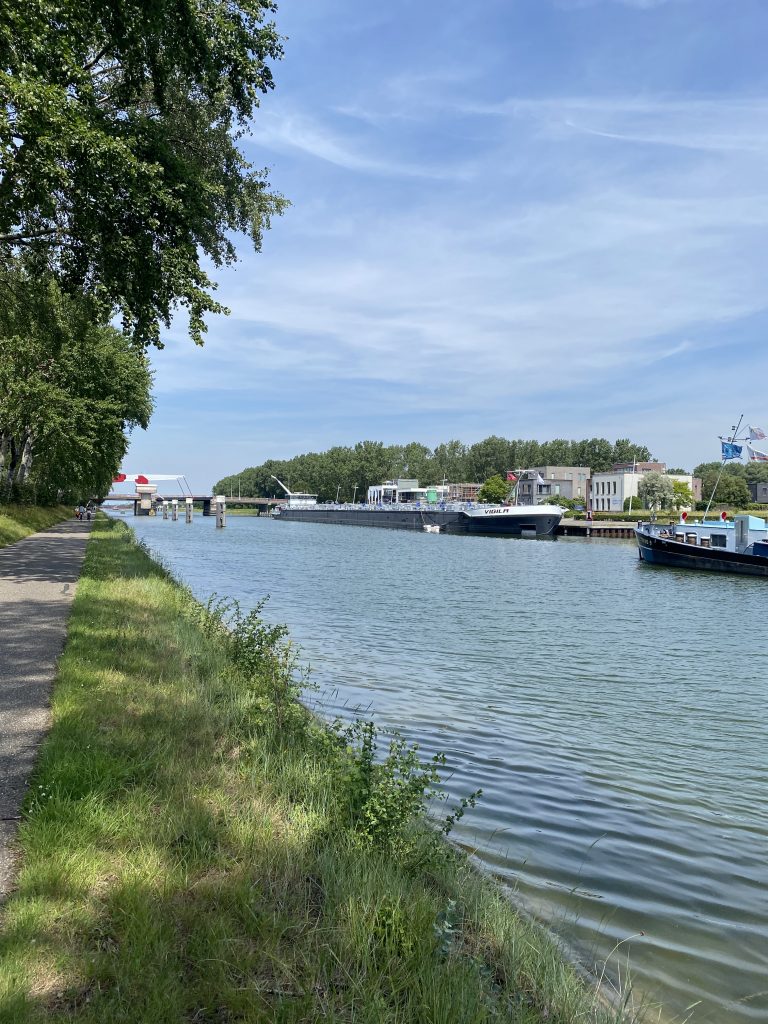
As we alighted the ferry, which was an equally efficient affair, it was a simple matter of picking up the canalside path route into Middelburg. I made a slight miscalculation once there and we had to use Google Maps to find our accommodation, which was a small family home. We had the house all to ourselves for the night, at a bargain price. Once we had all taken turns to shower we made our way to the town square where all the restaurants were. It was still hot as we walked through the streets of Middelburg.
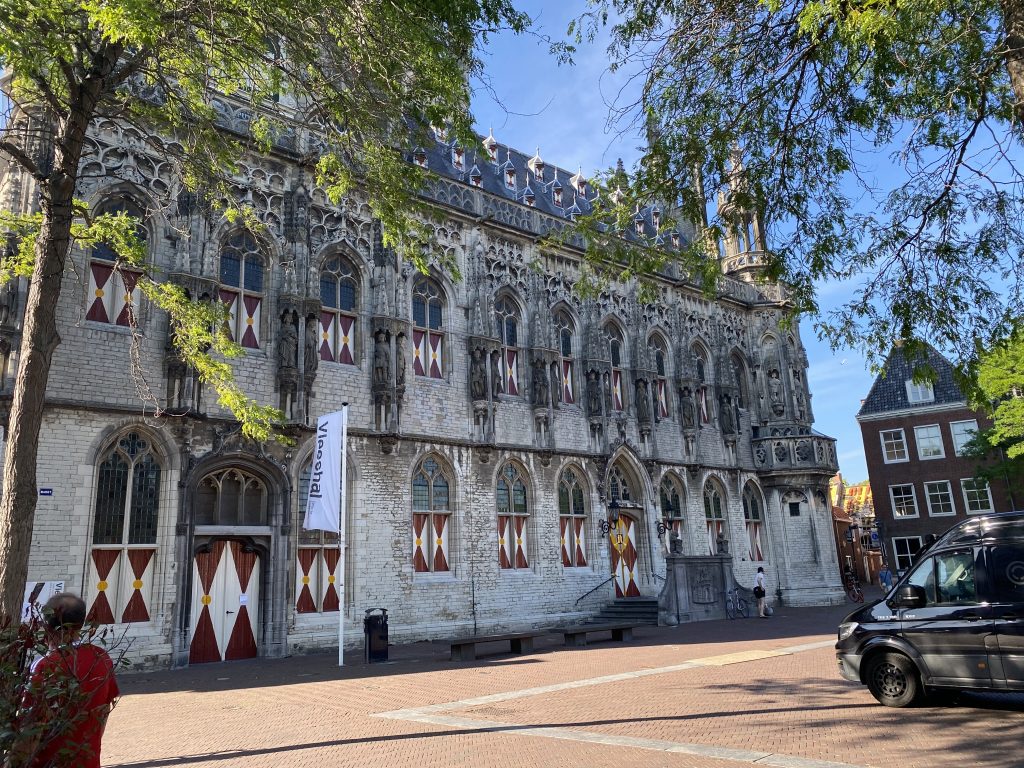
Middelburg sits within the province of Zeeland. The city was central to the lens cutting industry and is widely accredited for playing a key role in the development of the microscope and telescope, as well as spectacle making. Middelburg in fact dates back to the eight century, as a defensive fortification against Viking raids.
The main square was crowded with cafés and restaurants but as always finding a suitable place where there were ample choices for three meat eaters and a vegetarian was not a simple matter. In the end we made the wrong choice. The restaurant delivering a dish that was supposed to be a vegetarian risotto. It may well have been a risotto but the nutritional value was limited. This was a shame and no reflection on Middelburg which is a delightful place with plentiful choice of eateries.
Walking back to our accommodation we stopped by a small bar alongside the canal with small boats moored in a nearby wharf. We chatted and reflected on an enjoyable day. With the luxury of a bedroom each we were assured a good night’s sleep before our return to the overnight ferry in Rotterdam the following day.

Day 6
The main square in Middelburg provided the backdrop for yet another enjoyable breakfast in a market square. If the Dutch did Greggs it would be the Banketbakery. Fabulous choice, fast service and tasty. The staff could not be more helpful and we left with full bellies and warm hearts for our return ride to the Europport. I must say that in both the Netherlands and Belgium we received a warm welcome wherever we went. Apart from when I cut up a fellow cyclist. The Dutch follow the rules of the road and cycle lanes. This order works well until an unfamiliar touring cyclist from England appears, checking his Garmin rather than watching where he is going. I was correctly ‘told off.’
As we ate and observed the cycle bus of children riding to school it just felt like they had got things right. We popped into a supermarket to buy some supplies for the journey and Dave managed to purchase some batteries for his Di12 levers. He now had use of all 24 gears! Waiting outside we spoke with a young woman about the many cargo bikes we saw. The additional electric power makes them a practical alternative for transporting goods, shopping and small children. The lady explained that they were very expensive, around €5,000. She also told us that the Netherlands is the land of the bicycle and we would be able to use all the bridges on our journey today adding that her friend, who lives in the UK, never cycles now.
There was a cycle shop on outskirts of Middelburg. Dave stopped by to see if he could buy some tubeless sealant to top up what he had lost due to the rather large hole in his tyre. The shop owner recommended a type of reinflation sealant, similar to that which is provided with many cars these days. She was honest, informing Dave that this would work well but his tyre would need to be replaced when he returned home. Dave didn’t much care about that as he’s written off the tyre anyhow. It was turning his run of bad luck had changed.
That’s when disaster struck. I can only guess that the presta valve was incompatible with the canister. It worked but the foam went everywhere. On Dave, his bike and the shop window. Like all good mates we laughed our socks off at his panic, along with some helpful advice like; “you’d better wash the shop front.” Which Dave, being a gentleman, well a gentleman that swears a lot, did. Arriving from within the shop he was armed with a bowl of soapy water to wash the shop and the large amount of expanding foam from his rear hub and disc.

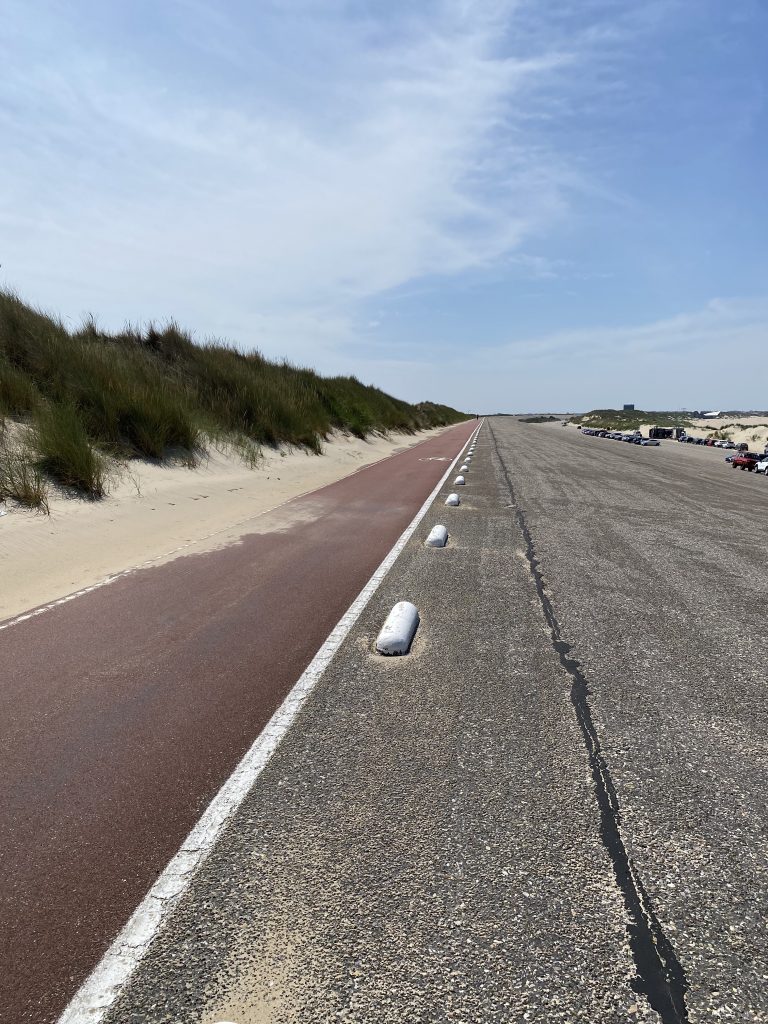
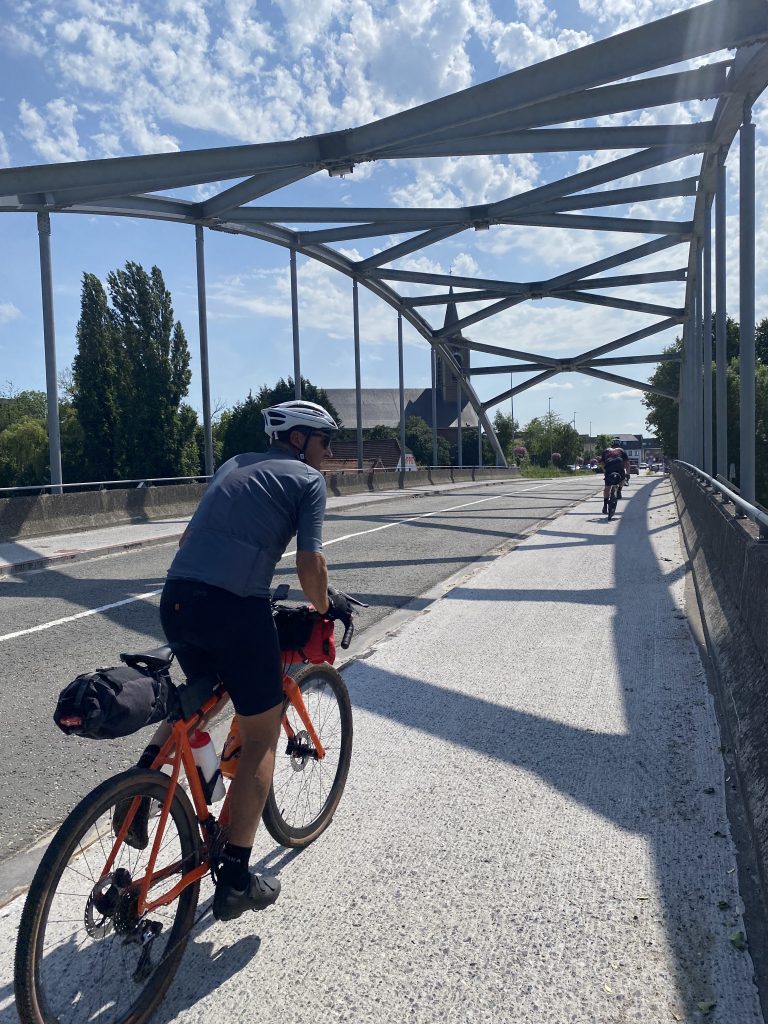
Once we had resolved the ‘expanding foam issues’ we set off for an incredible day’s cycling. Traversing the three expanses of water that made up the remaining estuaries to the North Sea. These bridges are incredible feats of engineering. At one point the road to our left was closed for a funfair. Once again it was a bright sunny and warm day. The wind was largely in our favour and the scenery was spectacular. I had warned my travel companions that if we were unlucky enough to face a northerly wind it would be hard going. I formed this opinion after seeing online videos of the ‘windy time trials’ held on these bridges. The participants are being blown off their bikes or riding at a virtual standstill. It was amusing to watch but I didn’t fancy the experience. Not when we had a ferry to catch at Europort.
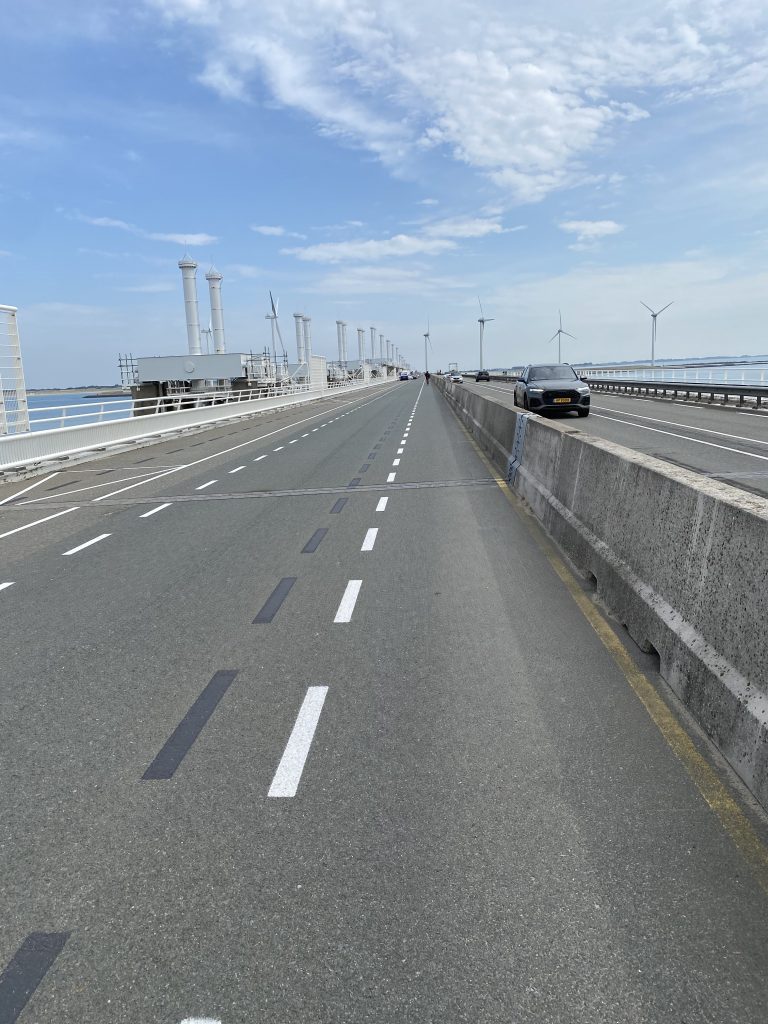
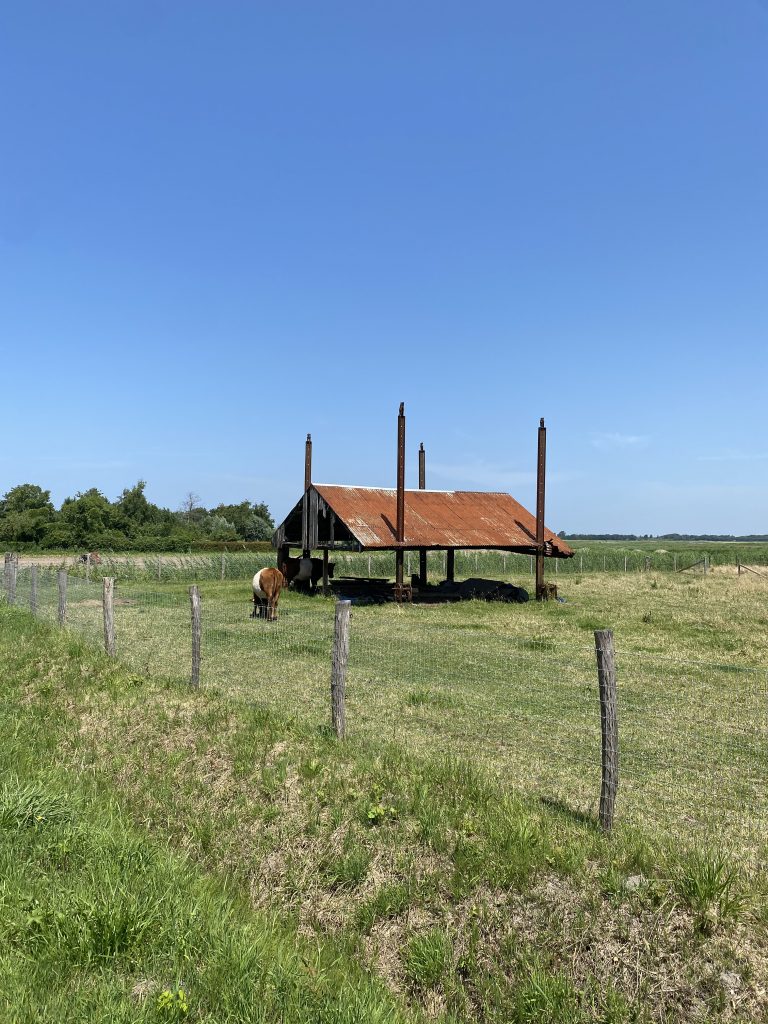
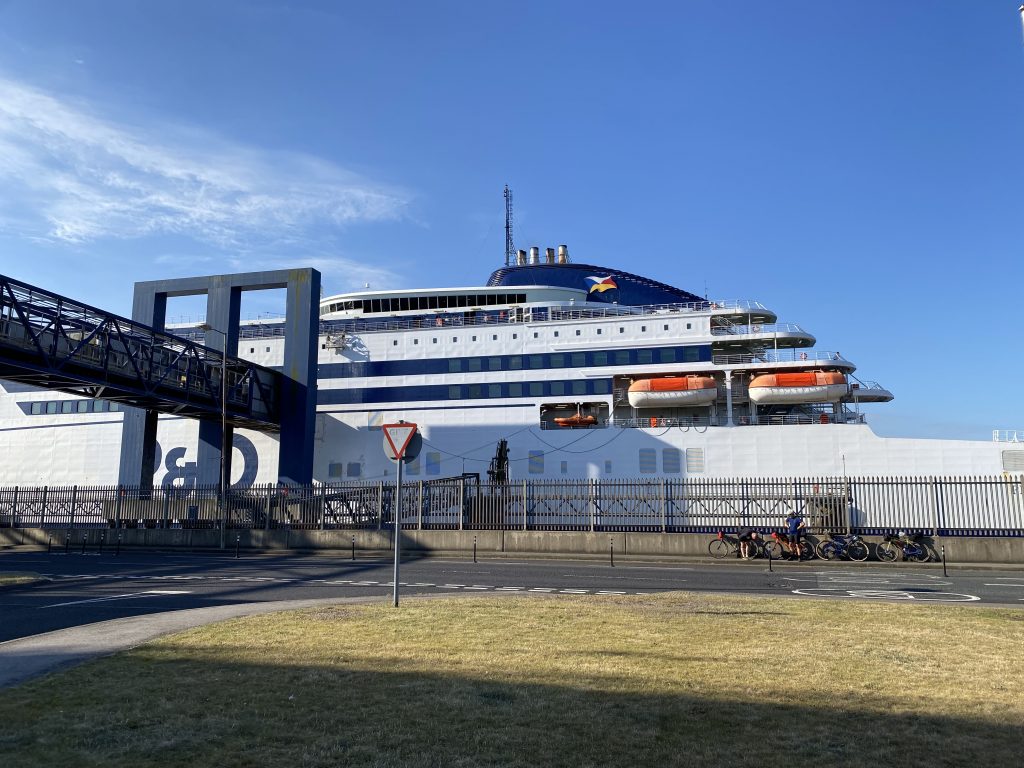
In truth the route provided yet another treat and memory from our Gravel Notts 2026 Tour. Arriving at the port was as previous, a seamless affair. Riding up the ramp Colin was in full flight, a much stronger rider than that of Day 1. Our bikes were secured on Deck 6 and we were showered and eating our evening meal before we knew it. A few drinks and watching the England World Cup game at nine. Struggling to stay awake until the end of the match. Lights out, next stop Hull.
Day 7 Return Home
At around 05.30 the announcement went out that breakfast was being served. We all met up in the restaurant and fuelled our bodies for a long ride home. The friendly banter was undiminished. In fact, it was replenished with new material acquired on each day of our ride. With our bikes packed up we were through passport control in reasonable time and on our way home. It was forecast to be the hottest day of the year in the UK with temperatures well in excess of 30 degrees. This in mind we all agreed that the sensible option was to follow a reverse route of our outward journey to Hull. To take on the planned 140 kilometres in the heat risked spoiling what had been an excellent tour. There is a well-used phrase, quit whilst you’re winning. So, we headed for Worksop to catch the train back to Nottingham. Still a ride of around 100 kilometres. That is if I didn’t take us down any closed roads or detours.
We were then met with the sad predictability of a cycling life in England. As we made our way out of Hull locals shouting abuse at us from the safety of their car, a guy overtaking us and then cutting left across my path as I led the group along a cycle path. A cycle lane that was the usual painted line in the road. The token effort. All negativity aside, once we were out of Hull the route became much more enjoyable. Learning from our mistake on the outward trip, avoiding the closed bridge and making good progress.
The heat was intensive and we were all flagging. It was a relief to arrive at the same excellent café near Misterton that we’d patronised on the way out. Four cold bowls of salad and rice with plenty of ice cold drinks. Exactly what was required.
After the lunch stop we arrived at an off road section of the route near Flixborough (north of Scunthorpe). There was a rocky section alongside a quarry which contributed to the upper bolt to my front rack searing off. With a team effort, a cable tie and some tape, we managed to secure the rack enough to get me home. This led to some banter as we totalled up the mechanicals each bike had experienced. Dave’s total being by far the greater with Colin and Andy experiencing none and myself just the one. Colin and Andy put this down to the superiority of their Sonder machines. Dave exclaimed that his mechanicals had been more masculine in nature. This misogynistic perspective of cycle mechanics sent me into a belly laugh that nearly killed me from the resulting choking fit whilst the other three looked on wondering whether or not to call an ambulance.
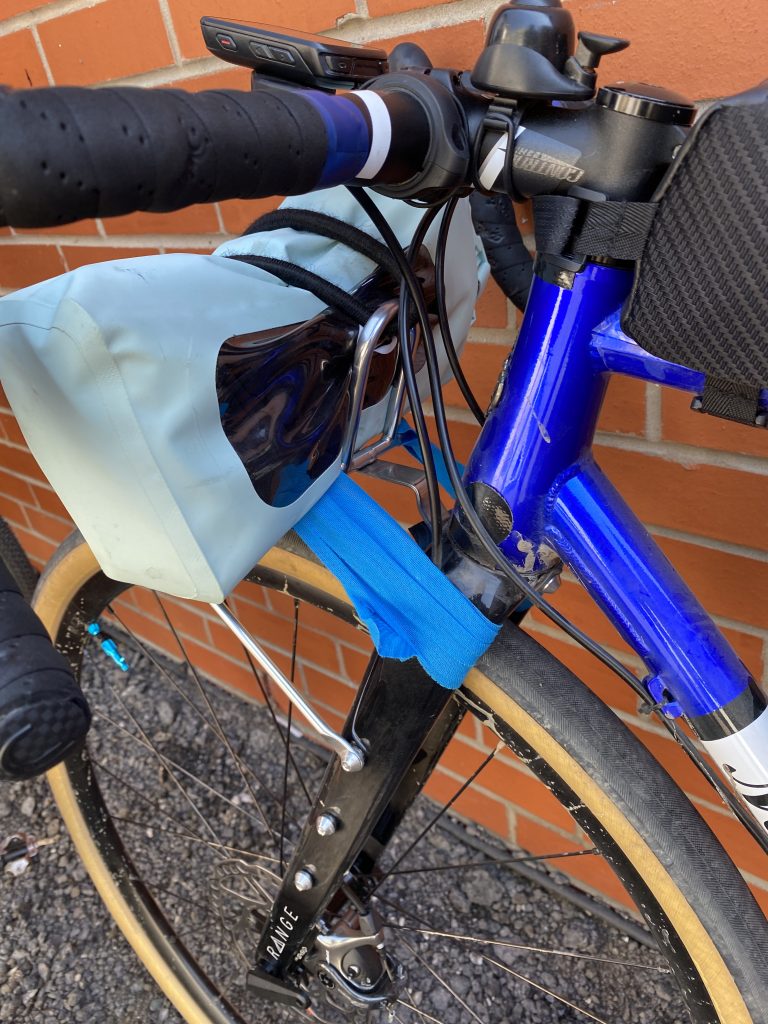
After Lound, and a repeat walk through the corn field, the route into Worksop was largely off road through Barnby Moor and beyond. A fast gravel section that was flat or downhill meant we were soon turning into the station carpark at Worksop.
We arrived at Worksop Station sometime after 14.00. It was just as well that we did. Trains were being cancelled due to the heat. The 14.36 was still running but the train after that had been cancelled. With one train normally scheduled every hour it would have been some wait had we have missed the 14.36. We were all ready to get home. Alighting the train in Hucknall I bid farewell to my travelling companions who were in turn alighting at Bulwell and Nottingham stations. I felt both joyful and emotional that the trip had come to an end. As always, it would take some adjustment back into regular life.
In summary
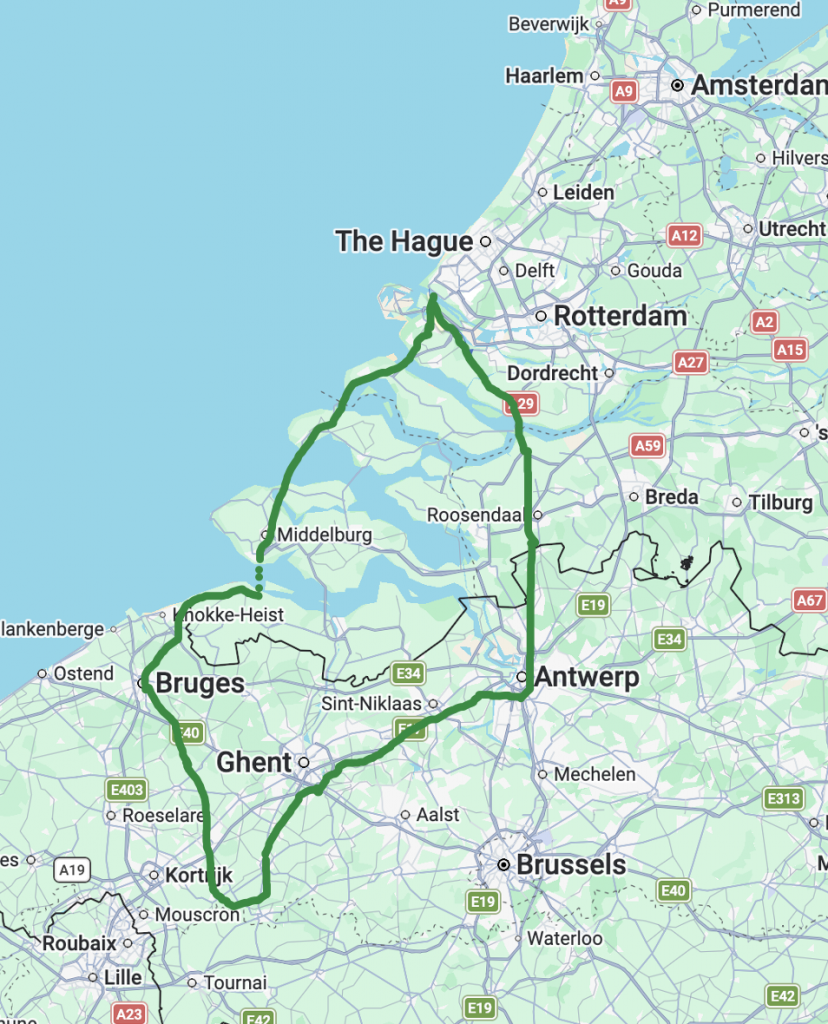
This was an excellent trip. In normal conditions it would have been a relaxing tour of 658 kilometres spread over seven days with little in the way of elevation gain. The heat however, made it a much more challenging affair. I guess that this is the new normal as the Earth warms. Highlights were definitely the safety of the route, incredibly well thought out cycle lanes, low traffic levels and the variety of bridges, ferries and picturesque small towns. So often the thing that I enjoy the most is seeing the ‘real’ places. The Koppenberg is an icon of Flanders so I was pleased to make its acquaintance if not conquer it.
The magnificence of the buildings in Antwerp, the river tunnel leaving the city, the beauty of our accommodation in the Flandrian countryside, the friendly and beauiful Middelburg and of course Brugge, probably the most impressive, whilst remaining compact, city I have ever visited.
Finally, it is worth mentioning that rolling on and off of the ferry from Hull, and back again was far less stressful than taking a packed bike box to an airport. It’s definitely a case of, will do something similar again.
And of course, cheers to my travelling companions.

Ride data
Day 1: Worksop to Hull – 104.55 km – elevation gain 520 m
Day 2: Europort (Rotterdam) to Antwerp – 124.66 km – elevation gain 283 m
Day 3: Antwerp to Beke – 94.76 km – elevation gain 247 m
Day 4: Beke to Brugge – 89.22 km – elevation gain 414 m
Day 5: Brugge to Middelburg – 57.43 km – elevation gain 128 m
Day 6: Middelburg to Europort – 90.39 km – elevation gain 234 m
Day 7: Hull to Worksop – 97.27 km – elevation gain 505 m
Total distance: 658 kilometres
Total elevation: 2,331 meters